9 Best Portable Lowrance Fish Finders (November 2026)
The best Lowrance portable fish finders include the LUCKY Kayak Portable Fish Depth Finder Water for simple kayak depth checks, the [FishPRO® 2026 Upgrade] NO.1 HD 1080P Underwater for ice fishing camera views, and the Humminbird 411660-1 Helix 5 Chirp GPS G3 for compact CHIRP and GPS.
On this page (8 sections)
- How these were compared
- Best Lowrance portable fish finder options, compared by mounting and power
- How to choose portable power for movable Lowrance sonar
- How to choose transducer mounting for a Lowrance you move
- Is a Lowrance portable fish finder better than a castable sonar?
- What size screen do you need for a portable fish finder?
- Should you consider a portable Garmin instead of Lowrance?
- Verdict: best Lowrance portable fish finder for your boat or kayak
The best Lowrance portable fish finder for most people is the Lowrance Eagle Eye 9. It gives you live sonar, CHIRP and DownScan in a 9-inch display that runs on battery power and connects directly to one transducer.
If you want the biggest Lowrance display you can still move by hand, choose the Lowrance Elite FS 10. Its 10-inch touchscreen and 3-in-1 transducer add SideScan and charting you do not get on the Eagle Eye 9.
Portable sonar has a trade-off. You gain freedom to move between boats, kayaks and rental rigs.
You lose the clean wiring, flush mount and permanent transducer placement of a fixed install. Our score weighs specs, features and buyer feedback against what you are shopping for here.
We compared these nine models by display size, depth range, power source and transducer type. We checked the specs for kayak, shore and boat use, and we matched each pick to a clear job so you can see which style of portable sonar fits your fishing.
How these were compared
We grouped the list by how you actually move each unit. Handheld and castable models were judged on range, beam coverage and how much you can see without a boat.
Bracket and transom models were judged on screen size, imaging, GPS and whether the transducer is included.
Depth figures were compared as stated maximums, not as a promise for your lake. Power was compared by what is included in the box and what you must add.
A model that lists battery powered use but ships without a large marine battery was treated differently from a kit that includes a battery and charger.
We also checked weight and dimensions where a model is meant to travel. A 10-inch head at 3.7 pounds or 4.8 pounds moves differently from a 3.2 ounce castable sonar that fits in a tackle box.
That difference shapes who should buy what, even when the larger unit has stronger sonar.
Our picks at a glance
-
1
 Best for simple kayak depth checks
LUCKY Kayak Portable Fish Depth Finder Water
9.7/10 our score
See it on Amazon -
2
 Best for ice fishing camera views
[FishPRO® 2026 Upgrade] NO.1 HD 1080P Underwater
9.7/10 our score
See it on Amazon -
3
 Best for compact CHIRP and GPS
Humminbird 411660-1 Helix 5 Chirp GPS G3
9.6/10 our score
See it on Amazon
- 4
 Check it
Humminbird XPLORE Series GPS Fish Finder MEGA
Best for large touchscreen imaging - 5
 Check it
Deeper PRO+ 2 Sonar Fish Finder
Best for castable wireless sonar - 6
 Check it
Lowrance Eagle Eye 9 Live Sonar Fish
Best for Lowrance live sonar portability - 7
 Check it
LUCKY Kayak Portable Fish Finder Transducer Wireless
Best for long-range castable sonar - 8
 Check it
Humminbird PiranhaMAX 4 Fish Finder with Transducer
Best for budget portable case use - 9
 Check it
Lowrance Elite FS Fish Finder/Chartplotter
Best for movable Lowrance chartplotters
Best Lowrance portable fish finder options, compared by mounting and power
The Lowrance models lead for Lowrance sonar, while the other picks show what true handheld and castable portability looks like. Choose by mounting first, then by power, then by screen size.
LUCKY Kayak Portable Fish Depth Finder Water: Best for simple kayak depth checks
- Depth range 3 ft to 328 ft
- 2-inch LCD
- Hull attach transducer
- 4 to 5 hour battery run in normal mode
A one-hand handheld for kayak and shore use, with a hull transducer for depth and fish location.
Pros
- One-hand handheld size
- Depth to 328 ft
- Neck strap included
Cons
- Display is not waterproof
- Simple LCD, not a chartplotter
This LUCKY handheld suits kayak anglers who want depth and fish location without wiring anything. The transducer attaches to the hull and the 2-inch LCD shows depth from 3 ft to 328 ft, plus weeds, sand and rocks.
Daily use is simple. You hold the unit in one hand, switch depth between feet and meters, and adjust sensitivity across 5 levels for clear or turbid water.
A neck strap keeps your hands free while you paddle. The unit measures 2.68 by 1.18 by 4.8 inches and weighs 0.58 kg, so it sits in a pocket or a kayak hatch without a bracket.
Battery life is listed at 4 to 5 hours in normal mode with a brand new battery, with a battery save mode for longer runs. The display is not waterproof, so keep it in a waterproof bag in spray.
It also has normal and demo modes, and the transducer needs full immersion for the stated depth range.
Against the Lowrance picks, it is far simpler and cheaper to move. It has no GPS, charts or imaging.
Pick it for basic depth work, not for mapping a lake.
[FishPRO® 2026 Upgrade] NO.1 HD 1080P Underwater: Best for ice fishing camera views
- HD 1080P camera
- 7-inch IPS monitor
- 10,000mAh battery
- 82 ft cable
An underwater camera system, not a sonar, for watching fish at the hole or near structure.
Pros
- Full colour IPS view
- Up to 20 hours stated
- USB-C charging while in use
Cons
- No sonar depth readout here
- No HDMI port and no video recording
This FishPRO system suits ice anglers and dock anglers who want to watch fish, not just mark them. It is a camera with a 7-inch IPS monitor and HD 1080P camera on an 82 ft cable, not a sonar fish finder.
You get IR and white LED light modes for dark water, plus a 45, 90 and 180 degree adjustable fin to angle the camera. FishPRO says the 10,000mAh battery gives up to 20 hours, and USB-C lets you charge while you fish.
The 1.8 mm cable is rated to 88 lb tensile strength, which matters when you lift the camera through an ice hole repeatedly.
The monitor and spool connect magnetically, so you can separate them or carry them together in the included box. The monitor measures 7 by 7 by 7 inches as a kit, and the 7-inch IPS panel keeps colour and contrast at wide viewing angles.
A flip-up cover doubles as a sun shade, and a backlight supports night fishing.
It scores high for clear underwater views, but it will not show depth, GPS or sonar arches. If you want Lowrance sonar, this is a complement for ice use, not a replacement.
Humminbird 411660-1 Helix 5 Chirp GPS G3: Best for compact CHIRP and GPS
- Dual Spectrum CHIRP
- GPS with basemap for 10,000+ lakes
- 5-inch display
- Transom mount transducer included
A compact 5-inch GPS fish finder with CHIRP and mapping, built around a transom transducer.
Pros
- CHIRP Wide and Narrow modes
- Built-in GPS basemap
- Keypad control for wet hands
Cons
- Corded power, not a sealed battery pack
- Transom mount is less movable than a suction mount
The Helix 5 suits boat anglers who want CHIRP and GPS in a compact 5-inch head. Dual Spectrum CHIRP offers Wide Mode for coverage and Narrow Mode for detail, with a Low-Q transducer for target separation.
GPS uses a basemap covering 10,000 plus lakes and continental US coastlines, and it works with premium LakeMaster, CoastMaster and Navionics charts. AutoChart Live can record up to 8 hours of mapping while you boat, which lets you build depth contours, bottom hardness and vegetation maps on water you already fish.
Keypad controls work in wet weather, which matters on an open boat. The unit measures 4.64 by 3.3 by 7.55 inches and weighs 2.1 pounds.
The included XNT 9 HW T is a transom mount transducer, so portability depends on how you mount that transducer.
It is corded electric, not a sealed battery kit. For a movable setup, plan your power and transducer mount before you buy.
It is more capable than basic portable heads, but less imaging focused than the XPLORE.
Humminbird XPLORE Series GPS Fish Finder MEGA: Best for large touchscreen imaging
- 10-inch touchscreen
- MEGA Side and Down Imaging+
- Dual Spectrum CHIRP
- Control head only, no transducer
A 10-inch control head for advanced imaging, but you must add a transducer for sonar.
Pros
- Large 10-inch touch display
- MEGA imaging range to 200 ft per side
- One-Boat Network connections
Cons
- No transducer in this version
- Large head is harder to move between small boats
The XPLORE suits anglers who want a large 10-inch touchscreen and advanced imaging. MEGA Side Imaging+ reaches 200 ft on each side and MEGA Down Imaging+ covers 200 ft of depth.
It also has Dual Spectrum CHIRP for fish detection and structure clarity. Built-in GPS, LakeMaster and CoastMaster VX cards for US and Canada, plus AutoChart Live with 8 hours of recording, make it a mapping tool.
The 10-inch Color TFT display supports both touchscreen and keypad operation, which helps when gloves or wet hands make touch input hard.
Bluetooth, Ethernet and NMEA 2000 support One-Boat Network use with Minn Kota and Cannon products. That helps if you plan to network a trolling motor later.
The control head measures 12.1 by 3.3 by 7.25 inches and weighs 4.8 pounds.
The key limit is clear. This is a control head only version with no transducer included.
You must add a compatible transducer. At 4.8 pounds and 12.1 inches wide, it is also the least kayak friendly head here.
Deeper PRO+ 2 Sonar Fish Finder: Best for castable wireless sonar
- Castable sonar
- Accuracy to 330 ft
- Built-in GPS
- Wide, mid and narrow beams
A pocket castable sonar with app display and GPS bathymetry for shore, kayak and dock use.
Pros
- Castable and wireless
- GPS mapping from shore
- Light at 3.2 ounces
Cons
- Phone app is the main display
- Narrow beam target separation is 0.4 in
The Deeper PRO+ 2 suits shore, dock and kayak anglers who want castable sonar without a boat mount. You cast the wireless sonar and view data in the app, with accuracy to 330 ft.
Wide, mid and narrow beams let you cover big areas or zoom on a spot. Target separation is 0.4 in on narrow beam and 1 in on wide and mid beams, which helps when you vertical jig.
That separation matters when fish hold close to a lure or when you try to tell a small fish from a larger one near the bottom.
Built-in GPS lets you create bathymetric maps from shore and save them in the Fish Deeper app. At 3.2 ounces and 2.56 inches across, it fits in a tackle box.
The package includes a neoprene pouch, attachment bolts and a USB wire, and the listed maximum depth is 100 meters.
It is battery powered and surface mount by design, so there is no transom or through hull work. The trade-off is phone dependence and no built-in screen like a Lowrance head.
Pick it for bank fishing and travel, not for high speed boat sonar.
Lowrance Eagle Eye 9 Live Sonar Fish: Best for Lowrance live sonar portability
- 9-inch IPS display
- Live Forward and Live Down
- CHIRP and DownScan with FishReveal
- C-MAP charts for 17,000+ US lakes
The most portable true Lowrance live sonar here, with one transducer and direct display connection.
Pros
- Live sonar in one package
- No separate sonar module needed
- 9-inch IPS screen
Cons
- Still needs a movable transducer mount
- Battery life depends on your separate pack choice
The Eagle Eye 9 is the best Lowrance portable fish finder here for live sonar on the move. Live Forward and Live Down views let you watch fish react to your lure in real time.
One included transducer delivers Live Forward, Live Down, CHIRP sonar and DownScan Imaging with FishReveal. FishReveal puts CHIRP fish targets over DownScan detail to make fish stand out near structure.
That combination is useful when you want imaging detail and a clear fish mark in the same view, rather than switching between separate screens.
The 9-inch IPS display connects directly to the transducer without a separate sonar module, which keeps rigging simpler when you move boats. C-MAP charts cover more than 17,000 US lakes, plus Genesis Live mapping.
The display unit measures 11.3 by 3.54 by 6.39 inches and weighs 2 pounds.
It lists battery powered use, panel mount and bracket mount, and a maximum depth of 500 ft. You still need to choose a movable transducer mount and a battery pack sized for your day.
That is the core portable power choice for a Lowrance live sonar.
LUCKY Kayak Portable Fish Finder Transducer Wireless: Best for long-range castable sonar
- Wireless castable sensor
- 853 ft operation distance
- 3.5-inch LCD
- Depth range 3 ft to 147 ft
A castable wireless sonar with a handheld display for shore, kayak and ice use.
Pros
- Cast or tie sensor to line
- 3.5-inch horizontal LCD
- Rechargeable handheld design
Cons
- Shorter depth range than the 328 ft LUCKY handheld
- No GPS or charting
This LUCKY castable sonar suits shore and kayak anglers who want wireless data on a handheld screen. You cast the sensor like a bobber and read a 3.5-inch LCD, with a stated 853 ft operation distance.
The wide 90 degree beam scans fish in 3 ft to 147 ft of water, and fish icons show depth next to each target. The screen scrolls right to left to show what just passed under the sensor.
That scrolling history helps you mark structure you have already passed, then cast back to the same area from shore or from a kayak that has drifted past it.
It is the second LUCKY here, but it plays a different role. The first LUCKY uses a hull transducer for depth to 328 ft.
This model trades depth range for wireless casting and a larger horizontal display. The handheld and sensor together are described as lighter than a 1-liter water bottle, and the listed weight for the unit is 0.7 kg.
There is no GPS, charting or imaging, and the sensor is tied to your line or safety tether. Pick it for bank, ice and kayak scouting where you cannot mount a transducer.
For Lowrance features, look at the Eagle Eye 9 instead.
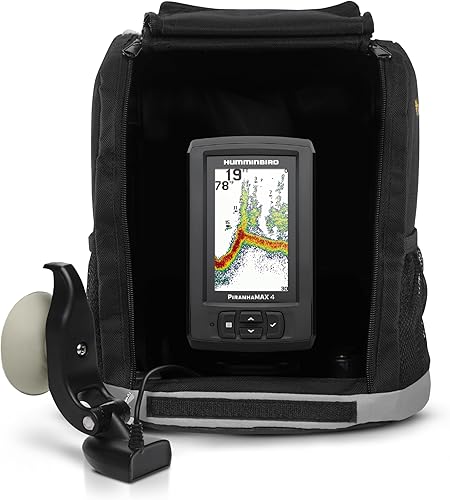
Humminbird PiranhaMAX 4 Fish Finder with Transducer: Best for budget portable case use
- Dual Beam Sonar
- 4.3-inch color LCD
- Portable carrying case
- 7 Amp Hour battery and wall charger included
A simple portable kit with case, battery and suction style portable transducer for moving between boats.
Pros
- Battery and charger included
- Soft-sided carrying case
- Narrow and wide beams
Cons
- Basic sonar, no GPS or imaging
- Portable transducer limits high speed use
The PiranhaMAX 4 suits budget buyers who want a complete portable kit in one box. It includes the fish finder, portable carrying case, portable transducer, 7 Amp Hour battery and wall charger.
Dual Beam Sonar gives you a narrow beam for detail and a wide beam for coverage. The 4.3-inch color LCD, Fish ID+, fish alarms, depth alarms and zoom keep the interface simple.
Narrow beam helps you separate fish near structure, while wide beam shows more water when you are searching a flat or a channel edge.
A tilt and swivel mount helps you set the viewing angle in a small boat or on ice. The soft-sided case protects the head during transport between vehicles and boats.
The unit measures 3.9 by 3.6 by 6.8 inches and weighs 2.5 pounds, so it fits in a cockpit storage box or a truck cab footwell.
It has no GPS, charts, CHIRP imaging or live sonar. A portable transducer also struggles at high boat speed compared with a fixed transom mount.
Pick it for simple moving between boats on a budget, not for advanced structure work.
Lowrance Elite FS Fish Finder/Chartplotter: Best for movable Lowrance chartplotters
- 10-inch multi-touchscreen
- Active Imaging 3-in-1 transducer
- CHIRP, SideScan and DownScan with FishReveal
- ActiveTarget 2 ready
A full Lowrance system you can bracket mount and move, with imaging and live sonar readiness.
Pros
- 10-inch touchscreen
- 3-in-1 imaging transducer
- Depth to 1000 ft
Cons
- Largest head here at 3.7 pounds
- Needs boat power planning for stays aboard
The Elite FS 10 suits anglers who want a full Lowrance chartplotter they can still move. Active Imaging 3-in-1 gives CHIRP, SideScan and DownScan with FishReveal in one transducer.
The 10-inch multi-touchscreen shows sonar, charts and connected controls with quick touch input. It is live sonar ready for ActiveTarget 2 or ActiveTarget 2 XL for real time fish and lure tracking.
That readiness lets you start with the included 3-in-1 transducer for imaging and CHIRP, then add live sonar later without replacing the display.
C-MAP Discover Onboard charts include inland, coastal and Canadian coverage, and networking via Wi-Fi, NMEA 2000 and Ethernet can link displays and equipment bow to stern. Maximum depth is listed at 1000 ft.
The head measures 12.81 by 4.47 by 8.26 inches.
At 3.7 pounds and 12.81 inches long, it is the largest head here. Bracket, surface and flush mounts are listed, but true portability means choosing bracket mount plus a movable transducer and a separate battery plan.
It is stronger than the Eagle Eye 9 for charting and imaging, and harder to carry.
How to choose portable power for movable Lowrance sonar
For a movable Lowrance, power decides how long you can fish away from a boat battery. The Eagle Eye 9 and Elite FS list battery powered use, but neither replaces a proper marine battery plan.
Start with your longest day, not your shortest. Add an hour for launch, idling and bright screen use.
A small lithium pack suits kayaks, while a larger deep cycle battery suits a 10-inch head used all day. Bright backlight settings and split screen views draw more power than a single sonar view, so plan for the screen layout you will actually use.
Battery options for a Lowrance you move between boats
Use a quick connect plug so you can lift the head off a bracket without rewiring. Store the battery upright, charge it before storage, and keep terminals dry.
If you need sizing help, read our guide to the best portable fish finder battery and match capacity to display hours. Also see [Do Fish Finders Really Work?
What to Know](/do-fish-finders-really-work/) before you expect sonar to find fish in every condition.
Power for kayaks versus motorboats
A kayak limits weight and space, so a compact lithium pack that fits in a hatch is easier to carry than a large deep cycle battery. A motorboat can carry more capacity, but you still need a plug that lets you remove the head for storage or for use on another boat.
Corded models such as the Helix 5 need a different plan. They expect boat power, so a portable battery must be wired through a suitable outlet and fused correctly.
Check the power source in the specs before you assume a head will run from a small pack all day.
How to choose transducer mounting for a Lowrance you move
Mounting matters more than brand for portable sonar. A fixed through hull transducer gives clean readings at speed, but it locks you to one boat.
For movable use, choose a suction cup mount, a transom clamp or the included bracket style mount. Test the angle at rest first, then check readings at slow speed before you trust marks at trolling speed.
A suction mount that holds at rest can lift or vibrate at speed, so test in stages and watch for air bubbles that break up the image.
Fixed mount versus movable mount
Fixed mounts win for a boat you own long term. Movable mounts win for rentals, kayaks, canoes and borrowed boats.
The Eagle Eye 9 direct connection helps here because you move fewer modules.
For boat based movers, our best portable fish finder for boat guide compares suction and transom options in more depth.
When a castable sensor replaces a mount
Castable sensors remove the mount question entirely. You tie the sensor to a line or tether, cast it where you want readings, and retrieve it by hand.
That works from shore, a dock or a kayak, but it does not give you continuous views while you motor across a lake.
Use a castable sensor for scouting a spot before you anchor. Use a transom or suction mount when you need steady readings while you move and fish at the same time.
Is a Lowrance portable fish finder better than a castable sonar?
A Lowrance head is better if you want charts, imaging and live sonar on a built-in screen. A castable sonar is better if you fish mostly from shore or a kayak and want no boat mount at all.
The Deeper PRO+ 2 and LUCKY MT-202 show the castable side. They use wireless sensors and app or handheld displays.
See How Does a Castable Fish Finder Work? What to Know for the limits of casting range and beam coverage.
For a wider view of handheld and castable styles, start with our best portable fish finder roundup, then come back to Lowrance if you want imaging and mapping.
Screen, charts and live sonar as the deciding factors
Castable models in this group do not offer C-MAP charts, SideScan or live forward sonar. They show depth, fish position and bottom type on a small screen or phone.
That is enough for many bank and kayak anglers who mainly need to know depth and where fish are holding.
Lowrance heads add charting and imaging that help you plan a day. A chart shows contours and structure before you launch.
SideScan shows structure beside the boat. Live sonar shows fish movement in real time.
If those views matter to how you fish, a movable Lowrance head is worth the extra rigging.
What size screen do you need for a portable fish finder?
A 5-inch screen suits basic CHIRP and GPS. A 9 or 10-inch screen suits live sonar, SideScan and split screen charting.
Bigger screens are easier to read in sun, but they weigh more and drain a portable battery faster.
The Helix 5 is 5 inches and 2.1 pounds. The Eagle Eye 9 is 9 inches and 2 pounds for the display unit.
The Elite FS 10 is 10 inches and 3.7 pounds. Match screen size to boat space before you match it to features.
If you want wireless convenience without a Lowrance screen, our best wireless portable fish finder guide covers castable and wireless sensor options.
Small screens for simple depth work
Handheld units with 2-inch to 3.5-inch displays are easy to carry and read at arm's length. They show depth, fish depth and bottom type in large numbers.
They struggle with split screen views, detailed charts and imaging, so they suit anglers who want a quick depth check rather than a full mapping system.
A small screen also helps battery life. You can run a handheld for hours on a small battery because the display draws less power and you use fewer views at once.
That matters on a kayak where battery weight is part of the load.
Should you consider a portable Garmin instead of Lowrance?
Choose Garmin if you already use Garmin networking, trolling motors or charts and want one brand across the boat. Choose Lowrance if you want ActiveTarget live sonar readiness, FishReveal and C-MAP charting in this group.
Neither brand is more portable by name alone. Portability comes from battery power, bracket mounting and a movable transducer.
Compare both ecosystems with our best Garmin portable fish finder picks before you commit to accessories.
Ecosystem and accessory costs to weigh
A display is only part of the system. Transducers, mounts, batteries, charts and networking cables add cost and complexity.
If you already own compatible accessories from one brand, staying with that brand can save money and reduce wiring changes when you move the head.
Check transducer compatibility before you buy. A control head only model such as the XPLORE needs a separate transducer.
A kit such as the Eagle Eye 9 or Elite FS includes a transducer, but you may still need a movable mount. Those details decide the true cost of going portable.
Verdict: best Lowrance portable fish finder for your boat or kayak
Pick the Lowrance Eagle Eye 9 if you want the best Lowrance portable fish finder for live sonar with simple direct wiring. Pick the Lowrance Elite FS 10 if you want a 10-inch chartplotter with SideScan and ActiveTarget readiness that you can bracket mount and move.
Pick the LUCKY handheld or Deeper castable if you fish from shore or a kayak and want no boat install. Pick the Humminbird PiranhaMAX 4 if you want the lowest cost complete portable kit.
Pick the FishPRO camera if your main goal is watching fish under ice rather than reading sonar.
Before you buy, decide your battery pack and transducer mount. That choice, more than the head alone, decides whether your portable Lowrance works well on day one.
Match the screen size to your boat, match the depth range to your water, and keep the weight in mind if you carry the unit by hand.
Our top 3 picks at a glance
-
1
Best for simple kayak depth checks
LUCKY Kayak Portable Fish Depth Finder Water
9.7/10 our score
See it on Amazon -
2
Best for ice fishing camera views
[FishPRO® 2026 Upgrade] NO.1 HD 1080P Underwater
9.7/10 our score
See it on Amazon -
3
Best for compact CHIRP and GPS
Humminbird 411660-1 Helix 5 Chirp GPS G3
9.6/10 our score
See it on Amazon
Frequently asked questions
Is there a truly portable Lowrance fish finder?
Yes, the Lowrance Eagle Eye 9 is the closest true portable Lowrance live sonar here. It pairs a 9-inch display with one transducer and battery power.
For full charting, the Elite FS 10 can be bracket mounted and moved, but it is a larger head.
What makes a Lowrance sonar portable?
Portable means you can move the display and transducer without a fixed install. Look for battery power, a gimbal or bracket mount, and a transducer you can move with a suction mount, transom bracket or castable sensor.
Fixed through-hull installs are not movable.
Do I need a separate battery for a portable Lowrance?
Most portable Lowrance heads list battery powered use but do not include a large marine battery in the box. Plan on a separate 12V marine battery or lithium pack sized for your day length.
Check our best portable fish finder battery guide for sizing help.
Can I move a Lowrance between a kayak and a motorboat?
Yes, if you use a bracket mount and a movable transducer mount. A suction cup or transom clamp lets you move the transducer without drilling.
Keep cables short and use a quick connect power plug so the head can lift off cleanly.


