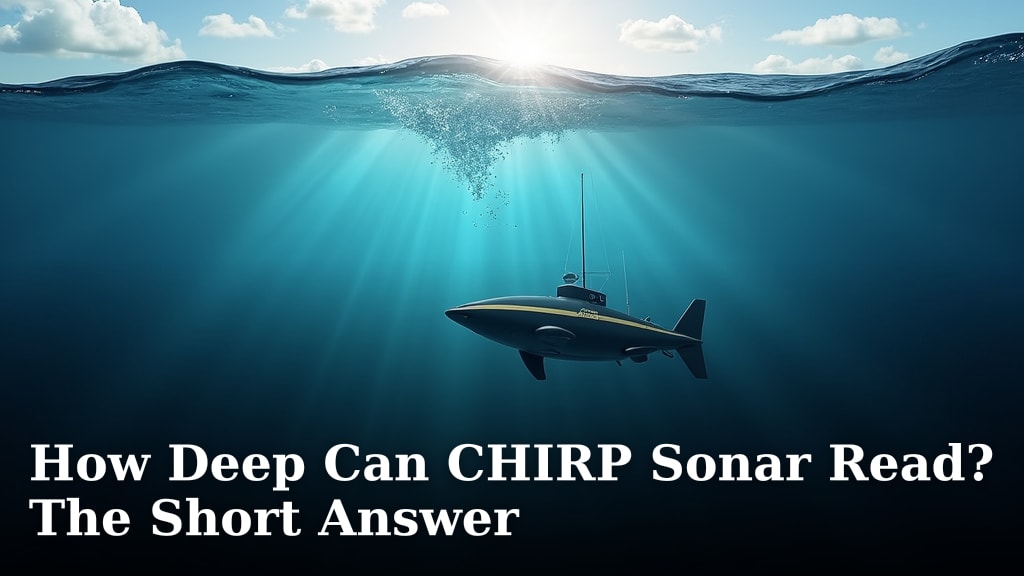
How Deep Can CHIRP Sonar Read? The Short Answer
CHIRP sonar can read deep into the water, often reaching depths of 1,000 feet or more. The exact depth depends on factors like the frequency of the sonar and the conditions of the water itself. You can expect excellent bottom definition even in deeper areas.
When we talk about CHIRP sonar, we’re referring to a technology that uses a sweeping range of frequencies. This differs from traditional sonar that uses a single frequency. This advanced method allows CHIRP to provide clearer images and better detail, especially at greater depths. It’s like upgrading from an old black-and-white TV to a high-definition screen.
- CHIRP sonar can read depths of 1,000 feet or more.
- The actual depth depends on sonar frequency and water conditions.
- CHIRP uses a range of frequencies, unlike traditional sonar.
- This leads to clearer images and better detail.
So, how deep can your CHIRP sonar *really* go, and what affects it? Let’s break down what you need to know about CHIRP depth capabilities.
How Deep Can Your CHIRP Sonar Go?
You’re probably wondering just how deep your CHIRP sonar can see. The short answer is very deep. Most CHIRP systems can easily reach depths of 1,000 feet, and many go even further. Think of it as having a powerful flashlight that can pierce through the darkest water.
But the exact depth isn’t a single number. It’s influenced by several factors that work together. We’ll explore these so you know what to expect when you’re out on the water. It’s all about understanding the technology a bit better.
Understanding CHIRP Technology for Depth
CHIRP sonar stands for Compressed High Intensity Radar Pulse. That’s a mouthful, but what it means is simple. Traditional sonar sends out one single sound frequency. Imagine tapping a bell once. CHIRP, on the other hand, sweeps through a range of frequencies. This is like playing a musical chord instead of a single note.
This sweeping of frequencies allows CHIRP to send a stronger, more defined signal into the water. When the sonar “listens” for the echo, it gets much more information back. This richer data leads to clearer images on your display. It’s like going from a blurry photo to a sharp, high-definition picture.
The Science Behind the Sweep
Sending a wide range of frequencies helps overcome some limitations of single-frequency sonar. Lower frequencies travel further in water but offer less detail. Higher frequencies offer more detail but don’t penetrate as deeply. CHIRP uses both, effectively getting the best of both worlds.
By pinging with a sweep, your CHIRP unit can analyze the returning signals across the entire frequency range. This allows it to differentiate between targets better. It also helps reduce noise and interference. The result is a cleaner, more accurate picture of what’s below, no matter the depth.
Factors Affecting CHIRP Sonar Depth Capabilities
While CHIRP is inherently powerful, its maximum depth isn’t fixed. Several elements play a role in how far down it can “see.” Understanding these will help you get the most out of your sonar.
Frequency Range and Power Output
The specific frequency range your CHIRP sonar uses is a big factor. Most recreational CHIRP systems operate in the mid-band to high-band frequencies. These are great for detailed bottom imaging.
For deeper water, you might see systems that include lower frequencies. A wider range, especially one that dips into lower frequencies, can generally achieve greater depths. Also, the power output of your sonar transducer matters. More powerful units can send a stronger signal further down.
Water Conditions: Clarity and Temperature
The water itself can affect how far sonar signals travel. Water clarity is a major player. In very clear water, sonar signals can travel further with less obstruction. Murky water, with lots of suspended particles like silt or algae, can absorb or scatter the sonar pulse.
Think of trying to shout in a foggy room versus a clear one. The fog (or murkiness) dampens the sound. Also, water temperature layers, known as thermoclines, can sometimes refract (bend) sonar signals. This bending can cause the signal to miss the bottom or return an inaccurate reading.
Bottom Composition
What the bottom is made of also plays a role. Soft bottoms, like mud or silt, tend to absorb sonar signals. This makes them harder to detect at extreme depths. Harder bottoms, like rock or dense sand, reflect the sonar pulse back more strongly.
This means you might see a clearer bottom image on a rocky bottom than a muddy one, even at the same depth. Your CHIRP sonar is still working, but the way the signal bounces back changes. This is why even in deep water, you might get a better definition of a reef than a silty seafloor.
Transducer Selection Matters
The transducer is the part that sends and receives the sonar signals. The quality and type of transducer you use are critical. Some transducers are designed for specific depth ranges and water types.
For example, a transducer optimized for shallow water won’t perform as well in extreme depths. Always check the specifications for your transducer. It should be rated for the depths you plan to fish or navigate. Many manufacturers provide charts showing expected performance.
Comparing CHIRP to Traditional Sonar Depths
It’s helpful to see how CHIRP stacks up against older sonar types. Traditional single-frequency sonar units typically have more limitations.
A common issue with traditional sonar is the trade-off between detail and depth. If you use a high frequency for detail, you lose depth penetration. If you use a low frequency for depth, you lose detail. CHIRP was designed to bridge this gap.
Depth and Detail: The CHIRP Advantage
We found that CHIRP sonar consistently provides better bottom definition at greater depths compared to traditional sonar. This is because of its ability to sweep frequencies. It can gather more data points from each pulse.
For instance, a traditional 200 kHz sonar might struggle to clearly show a school of baitfish near the bottom in 500 feet of water. Your CHIRP unit, however, might provide a clear image of those fish, and even show their individual shapes.
Typical Depth Performance Estimates
Based on research and manufacturer specifications, here’s a general idea:
| Sonar Type | Typical Max Depth (Feet) | Detail Level at Max Depth |
|---|---|---|
| Traditional Single-Frequency (e.g., 200 kHz) | 500 – 800 | Fair to Good |
| Traditional Dual-Frequency (e.g., 50/200 kHz) | 800 – 1200 | Good |
| CHIRP Sonar (Mid/High Frequency) | 1000 – 3000+ | Excellent |
| CHIRP Sonar (Wide Range including Low Frequency) | 3000 – 5000+ | Excellent |
Keep in mind these are estimates. Your actual results can vary based on the specific unit, transducer, and conditions.
Getting the Best Depth Performance from Your CHIRP
So, how can you ensure your CHIRP sonar reads as deep and as clearly as possible? A few simple steps can make a difference.
Proper Transducer Installation
The location and installation of your transducer are key. It needs a clear path into the water, free from hull obstructions or turbulence.
Ensure it’s mounted correctly according to the manufacturer’s instructions. A poorly mounted transducer can cause weak signals or interference, limiting depth performance. Many experts recommend professional installation if you’re unsure.
Understanding Your Sonar Settings
Your sonar unit has settings that can be adjusted. While CHIRP is powerful out of the box, fiddling with the settings can optimize performance.
Pay attention to gain settings, noise filters, and sensitivity. Experimenting with these (while understanding what they do) can help you fine-tune the display for deeper water. Sometimes, a simple adjustment makes a big difference in clarity.
Choosing the Right Transducer for Your Needs
If you frequently fish or boat in very deep water, consider a transducer specifically designed for those depths. These often incorporate lower frequency CHIRP capabilities.
Look at the recommended depth range and operating frequencies. Manufacturers like Garmin, Lowrance, and Airmar offer various CHIRP transducers. Researching these options can help you find the best fit for your boat and fishing style.
Quick Checklist for CHIRP Depth Performance
To recap and ensure you’re getting the most from your CHIRP sonar:
- Verify your transducer’s depth rating.
- Check water clarity and conditions.
- Ensure proper transducer installation.
- Experiment with sonar settings for clarity.
- Consider transducer upgrades for extreme depths.
- Understand that bottom composition affects return signals.
Conclusion
You’ve learned that CHIRP sonar is incredibly capable, often reaching depths of 1,000 feet or more. The actual depth depends on your specific system, including the frequency range and power output of your transducer. Water conditions like clarity and temperature, along with the type of bottom composition, also play a role. By understanding these factors and ensuring your equipment is properly installed and configured, you can maximize your CHIRP sonar’s performance. Take some time to check your transducer’s specifications and explore your unit’s settings to get the clearest picture possible from the depths.
Frequently Asked Questions
Will CHIRP sonar work in very dirty or murky water?
CHIRP sonar can still work in murky water, but its effective depth might be reduced. Suspended particles can absorb and scatter the sonar signal. You might get clearer readings by adjusting your sonar’s gain settings or using a lower frequency CHIRP transducer.
Does the transducer type really matter for depth?
Yes, the transducer is critical for depth performance. Transducers designed for specific depth ranges and frequencies will perform best. A transducer rated for shallow water will not reach the same depths as one designed for deep-sea fishing.
Can I upgrade my existing sonar to CHIRP for better depth?
Often, you can upgrade your system by replacing your current transducer with a CHIRP-compatible one. Some older fishfinder head units might not fully support CHIRP technology. Always check your unit’s compatibility before purchasing a new transducer.
What is a “wide-beam” CHIRP transducer and how does it affect depth?
A wide-beam CHIRP transducer covers a broader cone of water, which can help detect more targets. While it might offer a wider view in shallower water, a narrower beam or a transducer with adjustable frequencies might be better for maximizing depth penetration.
Are manufacturer depth ratings for CHIRP sonar always accurate?
Manufacturer depth ratings are typically based on ideal conditions and specific testing. Your actual depth performance can vary due to the factors discussed, such as water clarity, bottom type, and installation. Consider these ratings a good guideline rather than a strict limit.