6 Best Portable Fish Finder Battery (November 2026)
The best portable fish finder battery include the Reelsonar iBobber portable wireless bluetooth fish finder for castable shore fishing, the ECO-WORTHY Portable 12V Lithium Battery for Bluetooth monitoring, and the HWE Energy 12V 25Ah LiFePO4 Rechargeable Battery for longest runtime.
On this page (8 sections)
- Portable fish finder batteries compared for every setup
- How to compare portable fish finder batteries in this guide
- What size battery do you need for a portable fish finder?
- Which battery type is best for portable fish finders that use batteries?
- How do terminals and charging affect a portable fish finder battery?
- Which portable fish finder battery fits your boat, kayak or shore setup?
- How should you set up and care for a portable fish finder battery?
- Verdict: which best portable fish finder battery should you buy?
The best portable fish finder battery for most anglers is the HWE Energy 12V 25Ah LiFePO4, with the most capacity here and a clear LCD meter. If you want phone monitoring, the ECO-WORTHY 20Ah is the better pick.
If you fish from shore with no boat battery at all, the castable Reelsonar iBobber is the different kind of answer.
Portable sonar has two paths. One path is a separate 12V battery that powers a boat, kayak or dash-mounted unit.
The other path is a castable unit with its own rechargeable battery, like the iBobber. Both work, but they solve different fishing styles.
Our score weighs specs, features and buyer feedback against what you're shopping for. Capacity, weight, BMS protection and terminal type matter more here than raw power claims.
Our picks at a glance
-
1
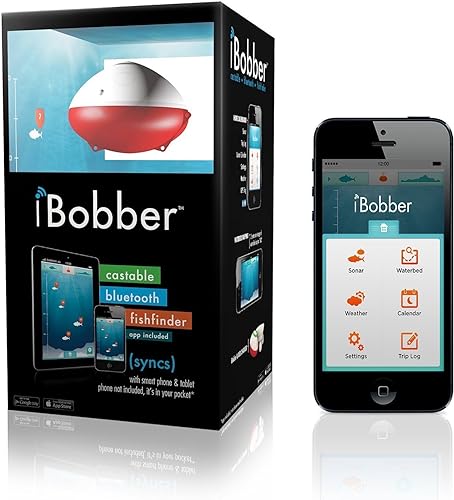 Best for castable shore fishing
Reelsonar iBobber portable wireless bluetooth fish finder
9.6/10 our score
See it on Amazon -
2
 Best for Bluetooth monitoring
ECO-WORTHY Portable 12V Lithium Battery
9.4/10 our score
See it on Amazon -
3
 Best for longest runtime
HWE Energy 12V 25Ah LiFePO4 Rechargeable Battery
9.3/10 our score
See it on Amazon
- 4
 Check it
Akiisolo 12V 15Ah Lithium Battery LiFePO4 Deep
Best with charger included - 5
 Check it
LiTime 12V 12Ah Mini LiFePO4 Battery
Best for tight spaces - 6
 Check it
LIPULS 12.8V 15Ah LiFePO4 Lithium Battery
Best for expandable setups
Portable fish finder batteries compared for every setup
The best portable fish finder battery depends on whether you need a castable sonar or a separate 12V battery. This section covers the six picks in score order, with the trade-offs that matter on the water.
Reelsonar iBobber portable wireless bluetooth fish finder: Best for castable shore fishing
- 135 feet depth range
- 10+ hours battery life
- Bluetooth with iOS and Android app
- Fish alarm and strike alert
A castable wireless sonar with 135 feet of depth range and 10+ hours of battery life. It pairs with a phone app for shore, dock and ice fishing.
Pros
- Castable and wireless
- 135 feet depth range
- 10+ hours battery life
Cons
- Depends on a phone app
- Smallest depth range here
The Reelsonar iBobber is the only castable sonar in this guide. It has a 135 feet depth range and 10+ hours battery life, and it syncs by Bluetooth to iOS and Android apps up to 100 feet away.
That makes it a true portable fish finder battery solution with no separate 12V pack to carry.
It suits shore anglers, dock anglers and ice anglers who want to cast out and watch a phone screen. The app shows depth-tagged fish icons color coded by size, plus bottom contours and structure.
Fish alarm and strike alert features help at night or under docks. You can also map waterbeds, mark spots, and log water temps, depth, lures, species and photos in a trip log for later review.
The trade-off is depth and screen size. At 135 feet it is fine for most freshwater, but a boat-mounted unit with a dedicated display will read deeper and be easier to see.
If you already own a boat sonar, this is a backup or a scouting tool, not a replacement. The pocket size at 2 x 2 x 1 inches also means it fits in a tackle box, but that small body leaves no room for a large built-in display.
ECO-WORTHY Portable 12V Lithium Battery: Best for Bluetooth monitoring
- 12.8V 20Ah LiFePO4
- Bluetooth 5.1 monitoring
- 20A BMS protection
- 4000+ cycles
A 20Ah LiFePO4 battery with Bluetooth 5.1 so you can check voltage, current and capacity on your phone. A 20A BMS covers overcharge, overload and short circuits.
Pros
- Bluetooth 5.1 monitoring
- 20A BMS protection
- 5A DC output port
Cons
- Heavier than the 15Ah picks
- No 5.5x2.5mm adapter wiring included
The ECO-WORTHY Portable 12V Lithium Battery is a 12.8V 20Ah LiFePO4 deep cycle battery with a built-in BMS and Bluetooth 5.1 monitoring. You can check battery voltage, current and capacity on your phone, which takes the guesswork out of deciding when to head back.
That phone check is useful when the battery sits inside a sealed kayak hatch or boat compartment where you cannot see a meter.
At 5.4 lb and 8.70 x 4.45 x 4.61 inches, it is a carryable pack for a kayak or a small boat. It has traditional terminals plus a 5.5x2.5mm DC port with 5A output, and ECO-WORTHY says to stay within that 5A limit to avoid heat buildup.
Note the 5.5x2.5mm adapter wiring is not included, so budget for that cable if your fish finder uses a barrel plug.
The 20A BMS protects against overcharge, deep discharge, overload, overheating and short circuits. ECO-WORTHY also lists low-temp cut off protection that stops charging below 20°F and discharge below -4°F, with auto-resume at 32°F.
That cold-weather behavior matters for ice fishing season, and it is a clearer protection story than the packs here with no stated low-temp cut off.
HWE Energy 12V 25Ah LiFePO4 Rechargeable Battery: Best for longest runtime
- 12V 25Ah LiFePO4
- LCD meter for voltage and SOC
- 20A BMS protection
- 5000+ deep cycles
The largest capacity here at 25Ah, with an LCD meter that shows voltage and power with one button press. It weighs 4.8 lb and supports series and parallel expansion.
Pros
- 25Ah capacity
- LCD voltage meter
- Supports series and parallel
Cons
- Not a starter battery
- Needs a lithium charger
The HWE Energy 12V 25Ah LiFePO4 is the largest capacity battery here at 25Ah. That extra amp hours means longer runtime on the same fish finder, which is the main reason it leads the 12V group.
HWE Energy says it offers up to 5000+ deep cycles and a lifespan up to 10 years, compared with 300-500 cycles for the sealed lead-acid batteries it replaces.
Its LCD meter shows real-time voltage and SOC with one button press. That display is a practical advantage over guessing from how the screen looks.
HWE Energy advises recharging with a lithium battery charger when below 20%. That 20% habit also helps the cells last longer, since deep discharge is where lithium packs age fastest in daily use.
At 4.8 lb and 7.12 x 3.03 x 6.65 inches, it is lighter than the ECO-WORTHY 20Ah despite more capacity. It has an M5 screw terminal, a 20A BMS, and supports series connection of 2 pcs for 24V 25Ah or parallel for 12V 50Ah, 75Ah or 100Ah.
This is not a starter battery, so it should not be used to crank an outboard. For a fish finder alone, that limit is not a problem, but it matters if you hoped for a dual-purpose pack.
Akiisolo 12V 15Ah Lithium Battery LiFePO4 Deep: Best with charger included
- 12.8V 15Ah LiFePO4
- Up to 8000+ cycles at 50% DOD
- Compatible charger included
- 12-month warranty
A 15Ah LiFePO4 battery that comes with a compatible charger. Akiisolo says it delivers over 2000 cycles at full capacity and up to 8000 at partial capacity.
Pros
- Charger included
- Lightweight at 3 lb
- Flat discharge curve
Cons
- 15Ah, not 20Ah or 25Ah
- Fewer published cycle details than rivals
The Akiisolo 12V 15Ah Lithium Battery LiFePO4 Deep is a 12.8V 15Ah pack that comes with a compatible charger. That included charger is the reason it stands out, since a separate lithium charger is a common extra cost with other picks.
If you are replacing a lead-acid pack and need correct charging logic from day one, having the charger in the box removes a compatibility question.
Akiisolo says the battery delivers over 2000 cycles at 100% DOD and up to 8000 cycles at 50% DOD, with up to 10 years of use. It weighs 3 lb, is 67% lighter than traditional lead-acid options by the brand's count, and has a wide temperature range of -20°C to +60°C.
In practice, that range covers hot summer decks and cold-season fishing without a special cold-weather mode to manage.
Its flat discharge curve keeps voltage steady for up to 95% of its capacity, so your fish finder screen should hold brightness late in the day. It supports parallel and series connections for higher voltage or capacity.
The trade-off is capacity: at 15Ah it will not outlast the 20Ah or 25Ah batteries on a long day. For most half-day and full-day kayak trips, 15Ah is plenty, but tournament anglers running large screens may want the extra headroom of the bigger packs.
LiTime 12V 12Ah Mini LiFePO4 Battery: Best for tight spaces
- 12V 12Ah LiFePO4
- 12A BMS protection
- 4000+ cycles
- IP65 waterproof
A compact 12Ah mini battery at 5.94 x 3.86 x 3.74 inches with a 12A BMS and IP65 waterproof rating. It fits fish finders, scooters and LED gear in tight spaces.
Pros
- Compact mini size
- IP65 waterproof
- SAE terminal
Cons
- Smallest capacity here
- Not Bluetooth version
The LiTime 12V 12Ah Mini LiFePO4 Battery is the smallest battery here at 12Ah. At 5.94 x 3.86 x 3.74 inches and 3.2 lb, it fits where a 20Ah or 25Ah pack will not.
That size advantage is worth more than extra runtime if your kayak hatch or battery box is tight. It also fits in a milk crate or soft tackle bag without taking the whole compartment.
LiTime lists 4000+ cycles, a 10-year life and low self-discharge, with a built-in 12A BMS for overcharge, discharge, current, temperature and short circuit protection. It is IP65 waterproof and uses an SAE terminal, which is common on portable sonar wiring.
The SAE plug matters because many existing 12V fish finder harnesses already end in SAE, so you may not need an adapter at all.
The trade-off is clear: 12Ah is the least runtime in this group. If you fish short trips of a few hours, that trade is fine.
If you run a large screen all day, step up to the 15Ah, 20Ah or 25Ah options. This is also not the Bluetooth version, so there is no phone app to check charge.
The 12A BMS is also lower than the 20A BMS ratings on rivals, which limits how much current you can safely pull at once if you later add lights or other accessories.
LIPULS 12.8V 15Ah LiFePO4 Lithium Battery: Best for expandable setups
- 12.8V 15Ah LiFePO4
- Built-in 20A BMS
- 192Wh capacity
- 4P4S flexibility
A 15Ah battery at 5.9 x 3.8 x 3.8 inches with a 20A BMS and 192Wh capacity. It connects up to 4 in series or parallel for up to 48V or 60Ah.
Pros
- 20A BMS protection
- 4P4S expansion
- Low self-discharge
Cons
- 12-month warranty only
- Fewer buyer reports than rivals
The LIPULS 12.8V 15Ah LiFePO4 Lithium Battery offers 192Wh at 12.8V 15Ah with a built-in 20A BMS. At 3.38 lb and 5.9 x 3.8 x 3.8 inches, it is compact and over 60% lighter than lead-acid by the brand's count.
That makes it easy to carry into a kayak or a tight boat compartment. The small footprint also leaves room for a charger, spare tackle, or a dry bag in the same box.
LIPULS says it delivers 4000+ full cycles and a 10-year design life, with ultra-low self-discharge for 1-year maintenance-free storage. The 20A BMS guards against overcharge, over-discharge, over-current, short circuit and over-temperature.
That protection suite matches the stronger BMS ratings in this guide, which is reassuring if you plan to run the pack hard or leave it stored between trips.
Expansion is its best feature. It connects up to 4 in series or parallel for up to 48V or 60Ah, which suits scaling a solar, trolling motor or off-grid setup later.
The trade-off is a shorter 12-month warranty and fewer buyer reports than the higher-ranked picks. For a single fish finder today, that expansion may be more than you need.
If you know you will add a trolling motor or solar panel next season, starting with an expandable pack can save you buying a second battery format later.
How to compare portable fish finder batteries in this guide
We compared amp hours, weight, BMS rating and terminals across all six picks. We checked the specs for capacity, voltage, size and cycle life, and we looked at how each battery's terminals match common fish finder wiring.
We also separated the one castable sonar from the five separate 12V batteries. A castable unit like the iBobber needs no wiring, while a 12V battery needs matching connectors and a lithium charger.
Both are valid portable fish finders that use batteries.
| Product | Best for | Maximum measuring depth | Power source | Item dimensions | Our score |
|---|---|---|---|---|---|
| Reelsonar iBobber portable wireless bluetooth fish finder | castable shore fishing | 135 feet | Battery Powered | 2 x 2 x 1 inches | 9.6 |
| ECO-WORTHY Portable 12V Lithium Battery | Bluetooth monitoring | 9.4 | |||
| HWE Energy 12V 25Ah LiFePO4 Rechargeable Battery | longest runtime | 9.3 | |||
| Akiisolo 12V 15Ah Lithium Battery LiFePO4 Deep | with charger included | 9.0 | |||
| LiTime 12V 12Ah Mini LiFePO4 Battery | tight spaces | 8.9 | |||
| LIPULS 12.8V 15Ah LiFePO4 Lithium Battery | expandable setups | 8.3 |
For a broader look at 12V options, our best fish finder battery 12v guide covers the same voltage class in more depth. If you are choosing a marine battery for boat use, that guide explains the step up from portable packs to boat batteries.
What size battery do you need for a portable fish finder?
Choose 25Ah for all-day trips, 20Ah for most kayak days, and 12Ah to 15Ah for short trips or tight spaces. Amp hours are the main driver of runtime on the same fish finder.
A 25Ah battery holds about twice the charge of a 12Ah battery. That does not mean exactly twice the hours, because your sonar draw and screen brightness change the math.
It does mean fewer midday battery worries.
If you run a small screen at low brightness, a 15Ah pack may cover a full day. If you run a large imaging unit at full brightness, the 25Ah HWE Energy is the safer choice.
Portable fish finder with battery setups reward extra capacity when weight is still low.
How do you estimate runtime before you buy?
Divide battery amp hours by your fish finder's current draw in amps. For example, 20Ah divided by 1 amp is a rough 20 hours before efficiency losses.
Real runtime will be less, so treat that number as a ceiling.
Check your sonar manual for its draw at your usual brightness. Many buyers run screens brighter than they need, which shortens runtime faster than any battery spec can fix.
How does watt hours change the comparison?
Multiply voltage by amp hours to get watt hours, which is a fairer way to compare packs at slightly different voltages. A 12.8V 15Ah pack holds 192Wh, while a 12V 25Ah pack holds about 300Wh.
That gap explains why the 25Ah pack lasts longer even though both are called 12V.
Use watt hours when you compare a 12Ah mini pack with a 20Ah pack. The 20Ah pack holds roughly two thirds more energy, so it should last noticeably longer on the same sonar.
Weight matters too, because a pack that is twice as heavy may not be worth it for a short bank-fishing trip.
Which battery type is best for portable fish finders that use batteries?
LiFePO4 lithium is the best type for most portable fish finder batteries. It is lighter than lead-acid, holds charge longer in storage, and tolerates deep discharge better.
Lead-acid batteries are cheaper upfront but heavier and shorter-lived. HWE Energy notes its 25Ah lithium at 4.8 lb replaces a 12 lb sealed lead-acid battery.
That weight saving matters in a kayak.
For the fuel cell of the argument, read Do Fish Finders Really Work? What to Know to judge whether a separate battery or a castable unit fits your water.
Also check What Is Sonar Sensitivity on a Fish Finder? so your battery power goes to a well-tuned screen.
What does BMS protection actually do?
A BMS is the battery's safety circuit. In this guide, BMS ratings range from 12A on the LiTime to 20A on the ECO-WORTHY, HWE Energy and LIPULS.
The BMS guards against overcharge, over-discharge, over-current, overheating and short circuits. It also balances cells.
You do not need to manage those risks yourself when the BMS is built in.
How do terminals and charging affect a portable fish finder battery?
Match the terminal type to your fish finder wiring, and use a lithium charger. SAE, M5 screw and DC barrel terminals all appear in this guide.
The LiTime uses an SAE terminal, the ECO-WORTHY uses M5 screw terminals plus a 5.5x2.5mm DC port, and the HWE Energy uses M5 screw terminals. Adapters can bridge gaps, but a direct match is cleaner and more reliable.
Charging matters just as much. HWE Energy says not to use a lead-acid charger for extended LiFePO4 charging.
The Akiisolo includes a compatible charger, which removes that concern for your first pack.
For charger shopping, see our best fish finder battery charger guide. For a ready-made setup, the best kayak fish finder battery kit guide matches batteries with wiring and chargers.
Can you expand a portable battery for more power later?
Yes, several picks here support series or parallel connections. The HWE Energy supports 2 in series for 24V 25Ah or parallel up to 100Ah.
The LIPULS supports up to 4 in series or parallel for 48V or 60Ah.
Only connect batteries that are fully charged separately first, as HWE Energy advises. Mixing charge levels in a series string can cause problems.
Start with one battery and expand only if your shared load truly needs it.
Which portable fish finder battery fits your boat, kayak or shore setup?
Kayak anglers should favor 12Ah to 20Ah packs under 5.4 lb, boat anglers should favor 20Ah to 25Ah packs, and shore anglers should consider the castable iBobber. Weight and fit drive this choice more than capacity alone.
Our best battery for kayak fish finder guide sizes packs for hatch and milk-crate storage. Kayak batteries must also resist splashes, so a sealed box or a waterproof-rated pack helps.
Brand-specific needs also matter. The best battery for garmin fish finder guide and the best batteries for Garmin STRIKER Vivid 4cv guide match Garmin draw and connectors.
For Lowrance users, the best battery for Lowrance Eagle Eye 9 guide covers that transducer's demand. Forward-facing sonar users should read the best forward facing sonar battery guide, since those units draw more power.
What about a battery for all your marine electronics at once?
A larger LiFePO4 pack can run more than sonar. Our best lithium battery for marine electronics guide covers shared packs for sonar, lights and accessories.
That is a bigger commitment than a sonar-only battery. A shared pack needs a clear wiring plan and a fuse between the battery and each device.
How should you set up and care for a portable fish finder battery?
Charge with a lithium charger, store at partial charge, and check voltage before each trip. Those three habits cover most portable battery care.
The HWE Energy LCD meter and ECO-WORTHY Bluetooth monitoring both make pre-trip checks easy. The LiTime and Akiisolo rely on low self-discharge, so a stored pack should still hold charge for months.
Keep terminals dry and tight. A loose M5 screw or a corroded SAE connector can cause voltage drops that look like a weak battery.
Wipe connectors clean and snug them before you launch.
Store batteries in a cool, dry place away from direct heat. Avoid leaving a pack in a hot car trunk all summer.
Use the pack every few months and top up the charge if it drops low.
Verdict: which best portable fish finder battery should you buy?
Buy the HWE Energy 12V 25Ah for longest runtime, the ECO-WORTHY 20Ah for Bluetooth monitoring, and the Reelsonar iBobber for castable shore fishing. Those three cover most portable sonar setups.
Pick the Akiisolo 15Ah if including a charger saves you a separate purchase. Pick the LiTime 12Ah if space is your main limit.
Pick the LIPULS 15Ah if you plan to expand to 48V or 60Ah later.
Before you order, measure your battery box and check your fish finder voltage and connector type. That one check prevents more returns than any spec comparison.
Our top 3 picks at a glance
-
1
Best for castable shore fishing
Reelsonar iBobber portable wireless bluetooth fish finder
9.6/10 our score
See it on Amazon -
2
Best for Bluetooth monitoring
ECO-WORTHY Portable 12V Lithium Battery
9.4/10 our score
See it on Amazon -
3
Best for longest runtime
HWE Energy 12V 25Ah LiFePO4 Rechargeable Battery
9.3/10 our score
See it on Amazon
Frequently asked questions
How long will a portable fish finder battery last?
Runtime depends on your fish finder draw and the battery amp hours. A 25Ah battery will run longer than a 12Ah battery on the same unit.
Check your sonar manual for its current draw, then divide amp hours by that draw for a rough hour estimate.
Can I use a lead-acid charger on a LiFePO4 battery?
HWE Energy says not to use a lead-acid charger for extended charging of LiFePO4 batteries. Use a lithium battery charger for best results.
An emergency charge with a lead-acid charger is an exception, not a routine plan.
What voltage do most portable fish finders need?
Most portable sonar setups in this guide use a 12V battery. Confirm the voltage your unit and wiring require before you buy.
A 12.8V LiFePO4 battery is the common modern choice for 12V fish finder setups.


