Flasher vs Sonar for Ice Fishing: Which Should You Choose? (November 2026)
Pick a flasher if you jig in one hole and a scrolling sonar if you want history and maps. In flasher vs sonar for ice fishing, the best display is the one that matches how you move, jig and read depth under the ice.
On this page (14 sections)
- Flasher vs sonar for ice fishing: the quick verdict
- The two side by side: flasher dial vs scrolling screen
- How a flasher display works under the ice
- How a scrolling sonar display works under the ice
- Which display is better for vertical jigging?
- Which display is better for reading depth and bottom?
- Which display is better for scouting new holes?
- How do beam width and cone angle change the choice?
- How do gain, sensitivity and zoom affect your screen?
- Which option is easier in cold weather and low light?
- What about light attraction and lure add-ons?
- Who should buy which display?
- What care and setup should you plan for?
- Flasher vs sonar for ice fishing: the final verdict
Pick a flasher if you jig in one hole and a scrolling sonar if you want history and maps. In flasher vs sonar for ice fishing, the best display is the one that matches how you move, jig and read depth under the ice.
A flasher shows each return as a flash on a dial. You see your lure, fish and bottom in real time, with no delay and no scroll.
A scrolling sonar shows returns as they move down the screen. You see depth history, fish movement and bottom changes over time.
We compared specs, features and buyer patterns for the picks below. Our score weighs specs, features and buyer feedback against what ice anglers need on the ice.
 Best for jigging in one hole
Humminbird ICE 55 Flasher Ice Fishing Fish
 Best for adding light attraction
DunkTeam LED Underwater Fishing Lures,LED Lighted Bait
Flasher vs sonar for ice fishing: the quick verdict
A flasher wins for vertical jigging, and a sonar wins for scouting and learning. The Humminbird ICE 55 is the strongest flasher pick here, with a 6-color fiber optic display and a transducer in the kit.
The Deeper PRO+ 2 and the LUCKY Portable are scrolling sonar picks. They show history on a screen and suit anglers who move between holes or want to map a flat.
The DunkTeam LED lures are not a display, but they can add light attraction to your rig. Choose based on your main method, not on brand.
If you sit over one hole and jig all day, a flasher gives the clearest feedback. If you drill, move and check many holes, a sonar screen gives more context.
The two side by side: flasher dial vs scrolling screen
A flasher shows instant returns on a dial, while a sonar scrolls returns down a screen. That one difference drives almost every other choice in this guide.
| Point | Flasher | Scrolling sonar |
|---|---|---|
| Display | Dial with colored marks | Screen with scrolling history |
| Best use | Vertical jigging in one hole | Scouting, history and mapping |
| Depth | Digital readout on many models | Depth scale plus history |
| Target separation | Strong in jigging range | Depends on beam and settings |
| History | None | Full scroll history |
| Cold use | Simple dial, easy to see | Screen needs care in cold |
| Portability | Small shuttle and transducer | Handheld or phone based |
You can turn to our guide on fish finder sonar types for a broader view of dial, screen and imaging options. That guide helps you place flashers and scrolling sonars in the larger family of devices.
How a flasher display works under the ice
A flasher turns each sonar return into a colored mark on a dial. The dial spins, the mark lights up, and you see depth and target position at once.
The Humminbird ICE 55 uses a 6-color fiber optic display. Green marks often show weaker returns, while red marks show stronger returns.
You learn to read color, depth and movement without looking at a long screen.
Target separation is a key strength. Humminbird says the ICE 55 helps you tell bait from fish in jigging use.
That matters when a fish follows your jig and you need to know if the lower mark is your lure or a follower.
Adjustable gain and zoom help you fine-tune the view. Gain changes how much detail shows.
Zoom focuses on a strike zone.
Cold performance matters on ice. The ICE 55 is rated for use in temperatures as cold as -20 degrees.
The shuttle, bag and transducer are built for portable ice use.
How a scrolling sonar display works under the ice
A scrolling sonar keeps a record of returns as they pass. You see bottom, lure, fish and past movement stacked by depth.
That history helps you spot changes. A fish that crossed 10 seconds ago still left a mark, while a flasher shows only this moment.
Depth reading is often easier on screen. It shows a clear scale, bottom line and distance for each return, as [How Does Sonar Measure Depth?
The Short Answer](/how-does-sonar-measure-depth/) explains.
Sensitivity, zoom and beam shape what you see. See What Is Sonar Sensitivity on a Fish Finder? for how sensitivity changes the picture.
The Deeper PRO+ 2 shows sonar in a phone app. The LUCKY Portable uses a 2.4 inch LCD.
Both give history, but size and clarity differ.
Which display is better for vertical jigging?
A flasher is better for vertical jigging because it reacts with no scroll delay. Lift your rod and the mark rises.
Drop it and the mark falls.
A sonar also shows your jig, but the mark may trail as it scrolls. That trail can blur fast moves in deep water.
The ICE 55 has adjustable gain, zoom and a customizable target line. Those controls set a strike zone and focus on a narrow depth band.
Beam choice matters too. A narrow beam gives tighter separation in a small area.
A wide beam covers more water but merges close targets, as What Is a Sonar Cone Angle? Explained Simply shows.
The Deeper PRO+ 2 offers wide, mid and narrow beams. Its narrow beam has 0.4 inch target separation, so you can track a small lure near fish.
Which display is better for reading depth and bottom?
A sonar screen is better for reading depth patterns and bottom changes. You see bottom line, depth scale and history in one view.
A flasher still shows depth. The ICE 55 has a digital depth display and automatic depth scale on its center dial.
The difference shows when bottom changes. A scrolling screen keeps the old bottom visible as you move.
You can compare flat water with a drop or weed edge. A flasher shows only current depth.
The LUCKY Portable shows depth, contour, temperature and fish size with depth. It reaches 147 feet, so it will not cover very deep water.
The Deeper PRO+ 2 reaches 330 feet and has built-in GPS for bathymetric maps. On ice, lower it through a hole to map around you.
Returns are explained in What Is a Sonar Return? The Short Answer.
Which display is better for scouting new holes?
A sonar is better for scouting because it keeps history and can map. A flasher tells you about one spot at one moment.
When you drill a new hole, a sonar helps you compare it with the last hole. You can see if fish were active, if the bottom changed or if bait is present.
That memory helps you decide whether to stay or move.
The Deeper PRO+ 2 has built-in GPS and saves maps to the Fish Deeper app. You can mark productive areas and return to them later.
That feature suits anglers who fish many lakes or a large lake with scattered spots.
A flasher can still scout well if you move it from hole to hole. You get a quick read on depth, fish and lure response.
You just lose the history and map that a sonar keeps.
The LUCKY Portable has simulation and wireless modes. Simulation lets you learn the controls before you fish.
Wireless mode lets you drop the transducer in the hole and watch the handheld screen.
How do beam width and cone angle change the choice?
Beam width decides how much water you cover and how well you separate targets. Wide covers more area, while narrow gives more detail in a small cone.
The ICE 55 has dual frequency sonar with user-selectable beam options. You can switch wide to narrow as depth and fish behavior change.
The Deeper PRO+ 2 has wide, mid and narrow beams. Separation is 0.4 inch in narrow and 1 inch in wide and mid.
The LUCKY transducer has a 90 degree detect angle. That covers a lot of water but can merge close targets, which can make deep water jigging harder to read.
Think about lake depth first. In 20 feet, a wide beam may cover much of the water.
In 80 feet, it covers far more area and separation gets harder.
How do gain, sensitivity and zoom affect your screen?
Gain and sensitivity decide which returns show, while zoom decides which depth band you watch. Too much gain shows noise.
Too little hides small fish and lures.
The ICE 55 has adjustable gain and zoom. Raise gain until bottom and lure show clearly, then back off before noise fills the dial.
Zoom locks on to a strike zone.
The LUCKY Portable lets you set sensitivity, brightness, depth range, zoom, depth alarm and fish alarm. Those settings help tailor the 2.4 inch screen to shallow or deep water.
The Deeper PRO+ 2 uses an app and beam options to shape the view. Narrow beam and zoom help in vertical jigging.
Wide beam helps when you search a large area.
Set the display before you jig. Check gain with lure at bottom, lift it to check separation, then set zoom to active depths.
Which option is easier in cold weather and low light?
A flasher is often easier to read in bright sun, low light and cold. The dial is large, the colors are bright and the controls are simple.
The ICE 55 uses a bright fiber optic display with 3 or 6 color options in its bullet points, and a 6-color display in its main description. That brightness helps you see marks without shading the screen.
The Deeper PRO+ 2 is wireless and lightweight at 3.2 ounces. Cold can drain phone and sonar batteries faster, so a spare battery or a warm pocket helps.
Its OLED or small LCD display is not the main screen; your phone is.
The LUCKY handheld has a 2.4 inch LCD and a rechargeable battery. The maker says the handheld lasts 4 hours on a full charge and the sonar sensor lasts 10 hours.
Cold may cut that time, so charge both before you go.
Gloves matter too. A flasher dial with large controls is easier to use with gloves than a phone screen.
A sonar app may need bare fingers for maps and settings.
What about light attraction and lure add-ons?
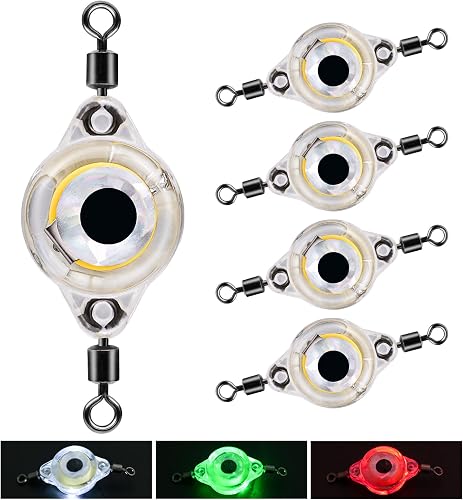
Light lures can help attract fish, but they do not replace a display. The DunkTeam LED lures are an add-on, not a finder.
The pack has 5 pieces of ABS plastic. It is water activated, so it lights in water and turns off out of water.
Battery life is up to 180 hours and it works over 3000 feet deep.
The fish eye design uses red, green and white LEDs that flash in turn. It is sealed and waterproof with a double ring buckle, listed for deep drop rigs, trolling flashers and ice fishing.
Use a light lure with a flasher or sonar, not instead of one. The display shows fish position and lure depth.
The light may draw fish into that cone, but it shows no depth or bottom itself.
Be careful in clear water. Some fish may approach, while others may spook.
Test it and watch the display for a change.
Who should buy which display?
Buy a flasher if you jig, and buy a sonar if you scout. That rule covers most ice anglers.
Buy the Humminbird ICE 55 if you fish one or two holes and jig with spoons, jigs or live bait. Its 6-color dial, target separation and dual frequency beams fit that style.
It comes with transducer, battery, charger and portable bag.
Buy the Deeper PRO+ 2 if you want mapping and a wireless castable design. It suits shore, dock or kayak use in warmer months plus ice.
GPS mapping and 330 feet of range add value beyond ice.
Buy the LUCKY Portable if you want a budget scrolling sonar with wireless transducer. Its 147 feet range, 2.4 inch screen and fish attractive lamp fit casual ice fishing.
Add DunkTeam LED lures for light attraction on deep drop or ice rigs. They are a low-cost add-on for anglers who already have a display, so pair them with a flasher or sonar.
What care and setup should you plan for?
Set up your display at home, then protect batteries and cables in the cold. Good setup saves time on the ice and keeps returns clear.
For a flasher, check gain, zoom and depth scale before you drill. Set the transducer cable so it hangs straight in the hole.
Keep the shuttle level so the dial reads correctly.
For a sonar, set depth range, sensitivity and zoom for your lake. Test wireless connection before you go outside.
Keep the transducer cable free of kinks and ice.
Batteries need care. Charge all batteries the night before.
Keep spare batteries warm in an inner pocket. Turn off alarms and extra features you do not need to save power.
Clean the screen and transducer after each trip. Dry cables before you coil them.
Store the unit in its bag or pouch so the screen and transducer do not get knocked around in a bucket.
Flasher vs sonar for ice fishing: the final verdict
Pick the Humminbird ICE 55 for jigging, the Deeper PRO+ 2 for mapping, and the LUCKY Portable for budget history. The DunkTeam LED lures are an add-on, not a display choice.
If you ask flasher vs sonar for ice fishing in simple terms, the answer is method first. A flasher gives instant feedback for vertical jigging.
A sonar gives history, depth patterns and maps for scouting.
Choose depth range to match your lake. The LUCKY reaches 147 feet, the ICE 55 reaches 200 feet, and the Deeper PRO+ 2 reaches 330 feet.
Deeper range helps in deep lakes, but beam width and separation matter more in most ice fishing water.
Start with one display that fits your main method. Learn its gain, zoom and beam settings well.
Add a second display or a light lure only when you hit a clear limit.
Frequently asked questions
Is a flasher or a sonar better for ice fishing?
A flasher is better for live jigging in one hole because it shows returns instantly. A scrolling sonar is better for history, depth patterns and mapping.
Pick by how you fish: still jigging favors a flasher, moving and scouting favor sonar.
Can a flasher show depth?
Yes, many flashers show a digital depth readout and a depth scale. The Humminbird ICE 55 has a center dial LCD with digital depth and automatic depth scale.
It reads depth well for one hole, but it does not scroll history like a sonar screen.
Is a castable sonar good for ice fishing?
A castable sonar can work through an ice hole, but casting is not possible on ice. The Deeper PRO+ 2 is wireless and portable, so you can lower it through a hole.
You lose the casting benefit on ice, but you keep mapping and beam options.
What depth do I need for ice fishing sonar?
Most ice fishing happens in water under 100 feet, but deeper lakes need more range. The LUCKY portable reaches 147 feet, the Humminbird ICE 55 reaches 200 feet, and the Deeper PRO+ 2 reaches 330 feet.
Match the range to your lake, not to the deepest claim.
Do I need a flasher and a sonar?
Most anglers need only one display. A flasher covers jigging and a sonar covers scouting and history.
Some anglers run both when they want live feedback plus a map.
Start with the display that matches your main method, then add the other if you hit a limit.