9 Best Fish Finders for Beginners (November 2026)
The best best fish finder for beginners include the LUCKY Kayak Portable Fish Depth Finder Water for kayak and shore beginners, the [FishPRO® 2026 Upgrade] NO.1 HD 1080P Underwater for ice fishing beginners, and the Humminbird 411660-1 Helix 5 Chirp GPS G3 for a first boat-mounted unit.
On this page (9 sections)
- How we compared the best fish finder for beginners
- The best fish finders for beginners, compared
- What is the best fish finder for beginners who fish from a boat?
- What is the best fish finder for beginners who fish from shore or kayak?
- How do easy to use fish finders for boats differ by screen and controls?
- Can a beginner learn sonar with a dual beam fish finder?
- How do you set up a fish finder for the first time?
- What is the best fish finder for beginners who want GPS?
- Verdict: which beginners fish finder should you buy?
The best fish finder for beginners is the LUCKY Kayak Portable Fish Depth Finder Water, because it gives you depth, fish location and bottom details on a simple handheld LCD without a boat mount. You can start with what to know about fish finders in our what to know about fish finders guide if you want a quick checklist before you compare models.
A good first fish finder should do three jobs well. It should show water depth in numbers you trust, mark fish in a way you can read at a glance, and stay simple enough that you use it every trip.
Extra features only help after those basics feel easy.
Our score weighs specs, features and buyer feedback against what you're shopping for. That means simple controls and readable displays score higher here than extra imaging modes that a new angler may not use yet.
Our picks at a glance
-
1
 Best for kayak and shore beginners
LUCKY Kayak Portable Fish Depth Finder Water
9.7/10 our score
See it on Amazon -
2
 Best for ice fishing beginners
[FishPRO® 2026 Upgrade] NO.1 HD 1080P Underwater
9.7/10 our score
See it on Amazon -
3
 Best for a first boat-mounted unit
Humminbird 411660-1 Helix 5 Chirp GPS G3
9.6/10 our score
See it on Amazon
- 4
 Check it
Reelsonar iBobber portable wireless bluetooth fish finder
Best for castable phone-based sonar - 5
 Check it
Humminbird XPLORE Series GPS Fish Finder MEGA
Best for beginners wanting imaging - 6
 Best for shore and dock fishingCheck it
- 7
 Check it
Deeper PRO+ 2 Sonar Fish Finder
Best for castable sonar with GPS maps - 8
 Best for simple auto-tuning sonarCheck it
- 9
 Check it
LUCKY Portable Fish Finder Handheld Kayak Fish
Best for budget handheld learning
How we compared the best fish finder for beginners
We compared 9 models by control type, display size, depth range, transducer style and how a new angler would actually use each one. Handheld and castable units scored well for ease of setup, while boat-mounted units scored for patience on the water.
We checked specs for each model, including display size, maximum depth, battery life and included hardware. We also looked at what each maker says about controls, alarms and mapping, and we matched those claims to beginner use cases like kayak, shore, dock and small boat fishing.
Trade-offs matter more than headline specs. A castable sonar is simple but needs your phone.
A boat-mounted unit gives you a fixed screen but needs mounting and power. An underwater camera is easiest to read but is not a sonar at all.
The best fish finders for beginners, compared
LUCKY Kayak Portable Fish Depth Finder Water: Best for kayak and shore beginners
- Depth range 3 ft to 328 ft
- 2 inch LCD display
- Backlight for sun or darkness
- Fish and fish school alarm
- 4 to 5 hours continuous use
A one-hand handheld unit designed for beginners, with depth, fish location, weeds and bottom type on a simple LCD.
Pros
- Simple controls for first time users
- Wide 328 ft depth range
- Portable for kayak, boat and shore
Cons
- Display is not waterproof
- Small 2 inch screen
The LUCKY Kayak Portable Fish Depth Finder Water suits beginners who fish from a kayak, small boat or shore and want a unit they can hold in one hand. Its 2 inch LCD shows depth, fish location, fish schools, weeds and bottom type like sand and rocks.
Depth detection runs from 3 ft to 328 ft when the transducer is fully immersed. That range covers most lakes, rivers and near-shore saltwater where a beginner will actually fish, so you will not outgrow it quickly.
Five levels of sensitivity adjustment help in clear or turbid water. You can also switch depth units between feet and meters, and turn on a backlight for darkness or bright sun.
Best for kayak and shore beginners who want simple controls and a readable display. The trade-off is that the display is not waterproof, and a 2 inch screen fills fast with detail, so keep it in a waterproof bag as the maker suggests.
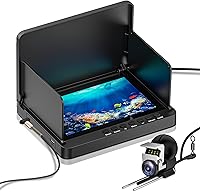
[FishPRO® 2026 Upgrade] NO.1 HD 1080P Underwater: Best for ice fishing beginners
- HD 1080P underwater camera
- 7 inch IPS monitor
- 82 ft cable with magnetic spool
- 10,000mAh battery, up to 20 hours
- IR and LED light modes
An underwater camera system that shows fish live on a 7 inch monitor, so you do not need to read sonar arches at all.
Pros
- Live video is easy to understand
- Large 7 inch IPS screen
- Long battery life up to 20 hours
Cons
- Camera system, not a traditional sonar
- 82 ft cable limits depth
The FishPRO NO.1 HD 1080P Underwater system suits ice fishing beginners who find sonar screens confusing. Instead of arches, you watch live HD 1080P video on a 7 inch IPS monitor and see fish approach your bait in real time.
The camera drops on an 82 ft cable with a magnetic spool, and the monitor has a built-in 10,000mAh battery rated for up to 20 hours. You can charge over USB-C while fishing, which helps on long ice days.
IR and LED light modes let you choose black-and-white or full-color views in dark water. The adjustable fin lets you set the camera angle at 45, 90 or 180 degrees to look around the hole.
Best for ice fishing beginners who want the clearest possible view. The trade-off is that this is a camera, not a sonar, and its 82 ft cable limits how deep you can watch.
It also does not include HDMI or video recording.
Humminbird 411660-1 Helix 5 Chirp GPS G3: Best for a first boat-mounted unit
- Dual Spectrum CHIRP sonar
- GPS with basemap for 10,000+ lakes
- 5 inch color display
- Keypad control
- AutoChart Live with 8 hours recording
A 5 inch boat-mounted CHIRP unit with GPS and mapping, built around keypad control that works in wet conditions.
Pros
- Boat-mounted GPS and mapping
- Keypad control for wet hands
- Wide and narrow CHIRP modes
Cons
- Requires transom mounting
- Corded power needs boat wiring
The Humminbird Helix 5 Chirp GPS G3 suits beginners whose first boat is a bass boat, pontoon or small cruiser and who want a fixed unit at the helm. Its 5 inch color display uses keypad control, which works reliably with wet hands and gloves.
Dual Spectrum CHIRP sonar gives you a wide mode for coverage and a narrow mode for detail. That helps you see fish arches and structure without learning a long settings menu first.
GPS comes with a Humminbird basemap covering more than 10,000 lakes and continental US coastlines. AutoChart Live can record depth contours, bottom hardness and vegetation for eight hours while you move.
Best for a first boat-mounted unit when you fish the same lakes often. The trade-off is installation, since it needs transom mounting and corded power.
If you want a smaller screen option, compare our best 5 inch fish finder guide.
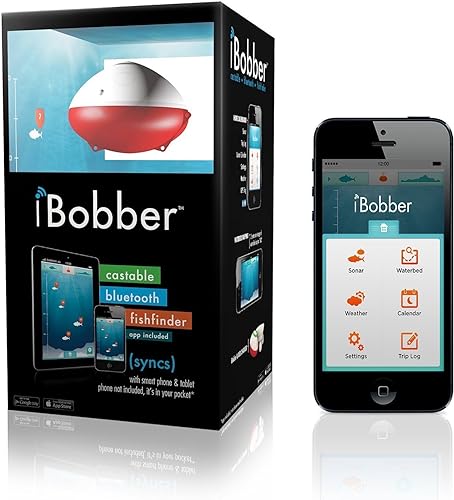
Reelsonar iBobber portable wireless bluetooth fish finder: Best for castable phone-based sonar
- Castable wireless sonar
- Depth range to 135 ft
- 10+ hours battery life
- iOS and Android app
- Fish alarm and strike alert
A small castable sonar that sends readings to your phone app, with depth-tagged fish icons coded by size.
Pros
- No boat mount needed
- Phone app shows fish by size and depth
- 10+ hours battery life
Cons
- You need a phone to see readings
- 135 ft depth range
The Reelsonar iBobber suits shore and dock anglers who want sonar without mounting anything to a boat. You cast the small wireless unit, and it sends readings to the free iOS or Android app over Bluetooth.
The app shows depth-tagged fish icons color coded by size, so you can tell a small fish from a larger one without reading raw sonar. Fish alarm and strike alert modes help when you fish ice, piers or docks.
Depth range reaches 135 ft, and battery life runs more than 10 hours. That is enough for a full morning or evening session from shore, with the app handling the display work.
Best for castable phone-based sonar if you already carry your phone fishing. The trade-off is dependence on a phone screen in sun and rain.
For a broader look at formats, see our fish finder types guide.
Humminbird XPLORE Series GPS Fish Finder MEGA: Best for beginners wanting imaging
- 10 inch touchscreen and keypad
- MEGA Side Imaging+ with 200 ft range each side
- MEGA Down Imaging+ to 200 ft
- Dual Spectrum CHIRP sonar
- Built-in GPS and LakeMaster map card
A large 10 inch imaging unit with touchscreen control, for beginners who want side and down views of structure.
Pros
- Large easy-to-read touchscreen
- Side and down imaging to 200 ft
- GPS maps for US and Canada
Cons
- Control head only, transducer not included
- Large 10 inch footprint
The Humminbird XPLORE Series suits beginners who want imaging views but still want a straightforward interface. Its 10 inch touchscreen display is large enough to read at a glance while you drive slowly over structure.
MEGA Side Imaging+ reaches 200 ft on each side, and MEGA Down Imaging+ covers 200 ft of depth. Dual Spectrum CHIRP sonar handles fish detection below the boat, so the unit covers both side scanning and classic sonar.
Built-in GPS includes a LakeMaster and CoastMaster VX map card for US and Canada regions. AutoChart Live can map depth contours, bottom hardness and vegetation with eight hours of built-in recording.
Best for beginners wanting imaging who fish from a larger boat with space for a 10 inch head unit. The trade-off is important: this is a control head only model without a transducer, so budget for that separately.
It is also the largest unit here.
Deeper Start Fish Finder: Best for shore and dock fishing
- Castable smart sonar
- Casts to 165 ft, depth to 165 ft
- 40 degree sonar beam
- Free Fish Deeper app for iOS and Android
- 6 hours battery life, 2.5 hour charge
A castable sonar for shore, dock and kayak use that shows fish location, size, depth and bottom contour in the app.
Pros
- Castable from shore or dock
- App shows depth and bottom contour
- Lightweight with no wires
Cons
- Phone required for display
- 50 meter maximum depth
The Deeper Start suits family and shore anglers who want to cast out and watch results on a phone. It creates its own Wi-Fi, so it does not use mobile data, and it saves scans with time and location.
The Fish Deeper app shows fish location and size, depth, bottom contour and vegetation in plain views. That is easier for a beginner than learning sonar arches on a small built-in screen.
It casts to 165 ft and reads to 165 ft depth with a 40 degree beam. Battery life is about six hours, with a full charge in 2.5 hours, which fits a casual trip from dock, bank or kayak.
Best for shore and dock fishing where you cannot mount a transducer. The trade-off is that you need a phone or tablet to see anything.
For depth-focused shopping, our best fishing depth finder guide breaks down depth-only options.
Deeper PRO+ 2 Sonar Fish Finder: Best for castable sonar with GPS maps
- Accuracy to 330 ft
- Wide, mid and narrow beams
- Built-in GPS for bathymetric maps
- Target separation 0.4 in narrow beam
- Free Fish Deeper app
A castable sonar with built-in GPS, so you can map depth contours from shore, dock or kayak and revisit them in the app.
Pros
- GPS mapping from shore
- Three beam widths
- 330 ft accuracy
Cons
- Phone required for full display
- Small unit, easy to lose if not tethered
The Deeper PRO+ 2 suits beginners who like the castable idea of the Start but want GPS mapping. Built-in GPS lets you create bathymetric maps from shore, dock or bank, and the app saves those maps for revisits.
Three beams, wide, mid and narrow, let you cover large areas or focus on a specific spot. Accuracy runs to 330 ft, with target separation of 0.4 inch on the narrow beam and 1 inch on wide and mid beams.
That separation helps when fish sit close to your lure during vertical jigging. The unit also creates its own dependable Wi-Fi for the app connection.
Best for castable sonar with GPS maps if you fish the same shore spots and want to learn bottom shape. The trade-off is still phone dependence for the display.
It is a step up in price and complexity from the Start, so choose based on whether mapping matters.
Lowrance Eagle Fish Finder: Best for simple auto-tuning sonar
- 4 inch IPS portrait screen
- Auto-Tuning Sonar
- 200 kHz Bullet Skimmer with 44 degree beam
- Fish icons with depth and zoom
- Twist-lock connector
A compact 4 inch unit with Auto-Tuning Sonar, so the settings adjust for you while you focus on fishing.
Pros
- Auto-tuning reduces setup
- Screen stays clear in sunlight
- Compact portrait design
Cons
- Small 4 inch screen
- No GPS in this model
The Lowrance Eagle Fish Finder suits beginners who want a boat unit that sets itself up. Auto-Tuning Sonar provides optimized settings automatically, so you can focus on finding fish instead of menu diving.
Its 4 inch IPS portrait screen stays clear in bright sunlight and through polarized sunglasses. Fish icons show depth, and zoom lets you look closer without an audible fish alarm.
The included 200 kHz Bullet Skimmer delivers a broad 44 degree beam for kayaks and small boats. A twist-lock connector makes connecting and removing the display simple, which helps with storage.
Best for simple auto-tuning sonar on a kayak or small boat where space is tight. The trade-off is a small screen with no GPS in this model.
If you plan to add GPS later, compare the Helix 5 above.
LUCKY Portable Fish Finder Handheld Kayak Fish: Best for budget handheld learning
- 2.4 inch TFT color LCD
- Depth detection to 328 ft
- 26 ft wired operating distance
- About 5 hours per charge
- Adjustable sensitivity, brightness, zoom and alarms
A budget handheld unit with color screen and adjustable settings, useful for learning depth and fish size on a kayak or boat.
Pros
- Color display at a budget price
- Adjustable settings for learning
- Wired transducer for kayak or boat
Cons
- Wired 26 ft operating distance
- Basic 200 kHz detection
The LUCKY Portable Fish Finder Handheld Kayak Fish suits budget-conscious beginners who want a color screen and adjustable settings. Its 2.4 inch TFT color LCD shows bottom contour, water depth, water temperature, fish size and fish depth.
Depth detection reaches 328 ft, with a 45 degree beam at 200 kHz and a 26 ft wired operating distance. You can adjust sensitivity, brightness, depth range, zoom, depth alarm, fish alarm, fish icon and units.
A simulation mode lets you try functions before you fish, which is useful for learning menus indoors. Battery life is about five hours per charge, with brightness control for night or sun.
Best for budget handheld learning on a kayak, boat or shore. The trade-off is the wired transducer and basic detection compared with CHIRP and imaging models.
It is a strong learning tool at the low end of this list.
What is the best fish finder for beginners who fish from a boat?
For boat fishing, the best fish finder for beginners is a boat-mounted unit with simple controls and a screen you can read while moving. The Humminbird Helix 5 Chirp GPS G3 fits that job with keypad control and a 5 inch color display.
Boat-mounted units stay in one place, so you learn the same screen every trip. That consistency helps you learn fish arches, bottom shape and depth changes faster than switching between handheld units.
Boat-mounted options to consider
The Lowrance Eagle is the simpler boat option here, with Auto-Tuning Sonar and a compact 4 inch IPS screen. It suits kayaks and small boats where a 5 inch head unit may crowd the mount.
The Humminbird XPLORE is the premium boat option, with a 10 inch touchscreen and imaging views. Choose it only if you have space and you plan to add a transducer.
What mounting means for a beginner
Transom mounting places the transducer on the back of the boat, which is the most common setup for the Helix 5. Through-hull and bracket mounts suit other hulls, so check your hull before you buy.
Power matters too. Corded units need boat power, while battery-powered units are simpler for small boats and kayaks.
Plan the mount and power route before the unit arrives.
What is the best fish finder for beginners who fish from shore or kayak?
For shore, dock and kayak fishing, the best fish finder for beginners is usually a handheld or castable unit you can move between spots. The LUCKY Kayak Portable Fish Depth Finder Water and the Deeper Start cover that need in different ways.
Handheld units attach a transducer to your kayak or boat hull and show readings on a built-in LCD. Castable units you throw out and watch on your phone, with no mount and no wires.
Handheld vs castable
Handheld LCD units work without a phone and keep working if your phone battery dies. Castable units reach farther from shore and map spots you cannot reach with a hull mount.
If you fish mostly from a kayak, a handheld unit with a neck strap and backlight is easy to use. If you fish from a dock or bank, a castable unit lets you scan water you cannot stand over.
Depth range for shore and kayak use
Most beginners fish in water under 100 ft deep, so a 135 ft or 165 ft range is often plenty. The LUCKY handheld reads to 328 ft, which gives headroom for deeper lakes and near-shore saltwater.
Frequency affects detail more than range for most beginners. Our fish finder frequency guide explains when a higher frequency helps in shallow water.
How do easy to use fish finders for boats differ by screen and controls?
Easy to use fish finders for boats differ most in screen size, control type and how much they adjust themselves. A beginner-friendly unit should show depth in large numbers and mark fish without a long menu.
Touchscreen units are intuitive but can be harder with wet fingers and gloves. Keypad units feel slower in menus but work reliably in any weather, which is why the Helix 5 uses softkey controls.
Screen size and readability
A 4 inch screen is compact and fine for a kayak, but detail gets small. A 5 inch screen balances size and space for most small boats.
A 10 inch screen is easiest to read but needs a larger helm and more power.
IPS screens keep contrast from wide viewing angles, which helps when you glance from the side. LCD screens with backlight help at night, as on the LUCKY handheld models.
Auto-tuning and simple fish ID
Auto-Tuning Sonar on the Lowrance Eagle reduces the settings a beginner must learn. Depth-tagged fish icons on the iBobber app do similar work by showing size and depth in one view.
Alarms for fish and depth can help, but they can also go off often in schools. Start with alarms off, then turn one on when you know what it sounds like in your water.
Can a beginner learn sonar with a dual beam fish finder?
Yes, a beginner can learn sonar basics with a dual beam fish finder, because wide and narrow beams teach coverage versus detail. The Deeper PRO+ 2 uses wide, mid and narrow beams for exactly that lesson.
A wide beam covers more water and helps you find fish schools. A narrow beam shows more detail and separates targets close together, which helps you judge size and position.
Our dual beam fish finder guide explains how the two beams work together. Read that before you buy an imaging model, since imaging adds a different kind of detail.
Learning one screen at a time
Start with depth and bottom contour before you chase fish icons. Those two readings teach you where fish hold, since structure and depth changes concentrate fish.
Then add fish size and depth. Finally, learn alarms and zoom.
That order keeps each trip simple and builds skill without menu overload.
How do you set up a fish finder for the first time?
Set up a fish finder by mounting or attaching the transducer first, then powering the display and choosing depth units. Most beginners should start in auto or default settings and adjust one thing at a time.
For handheld units, attach the transducer fully in the water and check that depth readings stabilize. For castable units, pair with the app and check that the Wi-Fi or Bluetooth connection holds at casting distance.
For boat-mounted units, confirm the transducer sits in clean water flow and the display has power. The Helix 5 includes a transom-mount transducer and gimbal bracket, so plan for that mount.
First trip settings to try
Sensitivity controls how much detail shows on screen. Higher sensitivity shows more in clear water but can add noise in weedy or muddy water.
The LUCKY handheld offers five levels, which is a good range to learn.
Zoom helps you read fish near the bottom. Brightness and backlight help in sun and darkness.
Our how to use a fish finder for beginners guide walks through those first settings step by step.
Care between trips
Keep displays dry, especially handheld units that are not waterproof. Rinse transducers and store cables without tight bends.
Charge batteries before storage, and check mounts after rough water.
What is the best fish finder for beginners who want GPS?
If you want GPS, the best fish finder for beginners is a boat-mounted unit or a castable with built-in GPS mapping. The Humminbird Helix 5 Chirp GPS G3 and the Deeper PRO+ 2 cover those two paths.
GPS helps you mark spots, return to structure and map depth contours over time. That learning loop is valuable for beginners who fish the same lake or shore area often.
Our best easiest to use fish finder with gps guide compares GPS models in more detail. Use it if mapping is your main reason to upgrade from a basic depth finder.
GPS features that matter first
Waypoint marking lets you save a specific rock pile, tree or drop-off. Basemap coverage shows lake outlines and coastal information without extra charts.
AutoChart Live and bathymetric mapping build depth maps as you move.
Start with waypoints and basemap. Add custom mapping only after you can read depth and fish on the main sonar screen.
Verdict: which beginners fish finder should you buy?
Pick the LUCKY Kayak Portable Fish Depth Finder Water if you want the simplest complete setup for kayak, boat or shore use, with depth to 328 ft and a handheld LCD. Pick the Humminbird Helix 5 Chirp GPS G3 if you fish from a boat often and want GPS, mapping and keypad control.
Pick the Deeper Start if you fish from shore or dock and prefer a castable phone-based view.
For ice fishing, pick the FishPRO camera system instead of a sonar, since live video is easier to read through a hole. For a first imaging experience, pick the Humminbird XPLORE only if you have helm space and plan to add a transducer.
Start with the job you do most, not the longest feature list. If you are unsure about formats, revisit our fish finder types guide and what to know about fish finders guide before you buy.
Then learn one screen well, and your next upgrade will feel natural.
Our top 3 picks at a glance
-
1
Best for kayak and shore beginners
LUCKY Kayak Portable Fish Depth Finder Water
9.7/10 our score
See it on Amazon -
2
Best for ice fishing beginners
[FishPRO® 2026 Upgrade] NO.1 HD 1080P Underwater
9.7/10 our score
See it on Amazon -
3
Best for a first boat-mounted unit
Humminbird 411660-1 Helix 5 Chirp GPS G3
9.6/10 our score
See it on Amazon
Frequently asked questions
What is the best fish finder for beginners?
For most new anglers, the LUCKY Kayak Portable Fish Depth Finder Water is the best fish finder for beginners because it is handheld, simple and reads depth to 328 ft. If you fish from a boat and want GPS, the Humminbird Helix 5 Chirp GPS G3 is a better step up.
Are fish finders hard to use?
Basic fish finders are not hard to use. Handheld and auto-tuning models show depth and fish icons with little setup.
Imaging models add more settings, so start with a simple display and learn one screen at a time.
What should a beginner look for in a fish finder?
Look for simple controls, a readable display in sunlight, and a transducer that suits how you fish. Castable models suit shore and kayak use.
Boat-mounted models suit regular boat trips and add GPS and mapping.