9 Best Fish Finders for Small Boats (November 2026)
The best fish finders for small boats include the [FishPRO® 2026 Upgrade] NO.1 HD 1080P Underwater for viewing fish underwater, the LUCKY Kayak Portable Fish Depth Finder Water for handheld depth checks, and the Humminbird 411660-1 Helix 5 Chirp GPS G3 for GPS and CHIRP in a compact screen.
On this page (8 sections)
- How we chose fish finders for small boats
- Compare the best small boat fish finders
- Which fish finders suit small boats best?
- How do you choose a fish finder for a small boat?
- Is a smaller fish finder screen easier to use?
- Should you choose sonar or an underwater camera?
- What mounting and power checks matter on a small boat?
- Which fish finder should you choose for a small boat?
The Lowrance Eagle is the best fish finder for most small boats because its 4-inch portrait screen takes less console space than a larger display, and its transducer is included. For a portable setup, consider the LUCKY handheld; choose the Deeper PRO+ 2 if you want wireless castable sonar and app-based mapping.
A small boat fish finder needs to fit the boat as well as the fishing plan. If you fish coastal water, compare fish finders for saltwater.
Measure the console or rail, check where power and transducer cables can run, and leave space to reach steering and other controls.
For a broader comparison, see our guide to the best fish finder for boat use. Anglers with open, flat-bottom layouts may also want the best fish finder for a jon boat.
Our picks at a glance
-
1
 Best for viewing fish underwater
[FishPRO® 2026 Upgrade] NO.1 HD 1080P Underwater
9.7/10 our score
See it on Amazon -
2
 Best for handheld depth checks
LUCKY Kayak Portable Fish Depth Finder Water
9.7/10 our score
See it on Amazon -
3
 Best for GPS and CHIRP in a compact screen
Humminbird 411660-1 Helix 5 Chirp GPS G3
9.6/10 our score
See it on Amazon
- 4
 Check it
Humminbird XPLORE Series GPS Fish Finder MEGA
Best for detailed side imaging - 5
 Check it
Deeper PRO+ 2 Sonar Fish Finder
Best for castable sonar and mapping - 6
 Best for a compact fixed mountCheck it
- 7
 Check it
JOYWEE FF688C 3.5" Phiradar Color LCD Boat
Best for a small color display with alarms - 8
 Check it
LUCKY Kayak Portable Fish Finder Transducer Wireless
Best for wireless casting - 9
 Check it
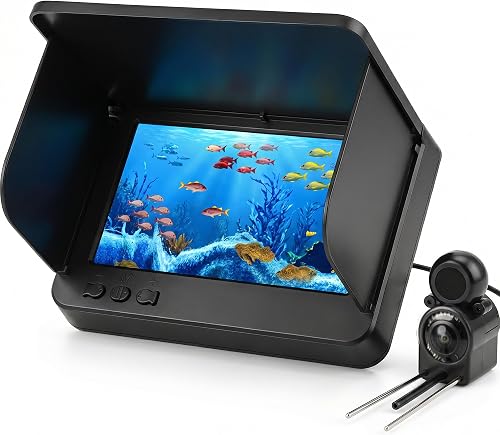
Takkicept Underwater Fishing Finder Camera
Best for a smaller underwater camera screen
How we chose fish finders for small boats
We compared display size, mounting approach, power needs and the included sonar or camera equipment. Our score weighs specs and features against the space-saving and practical setup needs of a small-boat owner.
A compact display alone does not make an installation easy. If you need to raise the screen for a clear view, compare tall fish finder mounts.
The bracket, transducer, cable path and power supply all need a place, so confirm the full setup before you buy.
Compare the best small boat fish finders
The comparison below separates fixed sonar units from portable units and underwater cameras. Check the display, installation style and included parts that matter for your boat.
| Product | Best for | Display | Cable | Power | Our score |
|---|---|---|---|---|---|
| [FishPRO® 2026 Upgrade] NO.1 HD 1080P Underwater | viewing fish underwater | 7 in IPS | 82 ft | 10,000mAh rechargeable battery | 9.7 |
| LUCKY Kayak Portable Fish Depth Finder Water | handheld depth checks | 2 in LCD | Battery powered | 9.7 | |
| Humminbird 411660-1 Helix 5 Chirp GPS G3 | GPS and CHIRP in a compact screen | 5 in color TFT | Corded electric | 9.6 | |
| Humminbird XPLORE Series GPS Fish Finder MEGA | detailed side imaging | 10 in color TFT | Battery powered | 9.5 | |
| Deeper PRO+ 2 Sonar Fish Finder | castable sonar and mapping | Battery powered | 9.2 | ||
| Lowrance Eagle Fish Finder | a compact fixed mount | 4 in IPS | Battery powered | 8.8 | |
| JOYWEE FF688C 3.5" Phiradar Color LCD Boat | a small color display with alarms | 3.5 in TFT LCD | DC, 10 to 18 V input | 8.8 | |
| LUCKY Kayak Portable Fish Finder Transducer Wireless | wireless casting | 3.5 in LCD | Battery powered | 8.2 | |
| Takkicept Underwater Fishing Finder Camera | a smaller underwater camera screen | 5 in IPS | 98 ft | 8,000mAh rechargeable battery | 7.9 |
Which fish finders suit small boats best?
These picks cover small fixed displays, handheld sonar, castable models and camera systems. Start with how you want to mount and power the equipment, then compare the detail each option provides.
[FishPRO® 2026 Upgrade] NO.1 HD 1080P Underwater: Best for viewing fish underwater
- 7-inch IPS monitor
- 82 ft camera cable
- 10,000mAh battery
- IR and LED lights
This underwater camera shows fish on a 7-inch screen and runs from its built-in rechargeable battery. It needs a secure spot for the monitor and room to manage the cable.
Pros
- Large IPS screen
- Built-in monitor battery
- USB-C charging
Cons
- Uses a camera rather than sonar
- No HDMI port or video recording
FishPRO is an underwater camera system, not a conventional sonar display. Its 7-inch IPS monitor shows the camera feed, while an 82 ft cable lets you lower the camera into the water.
The screen is larger than the mounted sonar displays in this roundup, so plan for a secure place to set or mount it. FishPRO includes a built-in 10,000mAh rechargeable battery and USB-C charging, which means this camera setup does not depend on a boat power connection for the monitor.
Its adjustable camera fin offers 45- and 90-degree angles, and the camera has IR and LED lighting modes. The system does not include HDMI or video recording, so choose it for viewing rather than saving footage.
Choose FishPRO if you want to watch fish and bait directly and can manage a large screen and cable. If you want sonar depth readings instead, compare it with the compact mounted and portable fish finders below.
LUCKY Kayak Portable Fish Depth Finder Water: Best for handheld depth checks
- 2-inch display
- Handheld design
- Depth range 3 to 328 ft
- Battery powered
A handheld display and transducer provide depth and approximate fish location without a permanently mounted screen. Keep the display protected from splashes.
Pros
- Small handheld display
- Shows depth and approximate fish location
- Neck strap included
Cons
- Display is not waterproof
- Needs batteries
The LUCKY handheld is a simple choice when you need a small display and basic depth information without installing a console unit. Its 2-inch screen shows water depth, approximate fish location, weeds and bottom types such as sand or rocks.
The transducer can attach to a kayak or boat hull, and the unit can also be used as a portable finder. LUCKY gives a depth detection range of 3 to 328 ft when the transducer is fully immersed.
The display is not waterproof, so keep it away from splashes or use a suitable protective case. It runs on batteries and includes a neck strap, which can help keep it close while your hands are busy.
Pick this model for handheld readings and a small footprint. If you want a dedicated mounted screen with GPS, the Humminbird Helix 5 is the more feature-rich option.
Humminbird 411660-1 Helix 5 Chirp GPS G3: Best for GPS and CHIRP in a compact screen
- 5-inch color display
- Dual Spectrum CHIRP
- GPS with Humminbird Basemap
- Transom-mount transducer included
This 5-inch unit combines Dual Spectrum CHIRP sonar and GPS mapping. Its transom-mount transducer and gimbal bracket suit a conventional fixed installation.
Pros
- CHIRP offers wide and narrow search modes
- GPS Basemap included
- AutoChart Live mapping
Cons
- Requires a wired installation
- Larger than handheld options
The Humminbird Helix 5 combines a 5-inch color display, Dual Spectrum CHIRP sonar and GPS in a fixed-mount setup. Its included transom-mount transducer and gimbal bracket are relevant if your boat has room for a conventional installation.
Wide Mode searches a broader area, while Narrow Mode gives a more focused view. The built-in Humminbird Basemap covers more than 10,000 lakes and continental U.S. coastlines, and AutoChart Live can create maps of depth contours, bottom hardness and vegetation.
This unit needs a suitable power connection and a route for the transducer cable. Measure the screen and bracket against your console before choosing it, especially if controls or other electronics share the same space.
Choose the Helix 5 if you want GPS mapping and CHIRP on a display that is still relatively compact. For more advanced side imaging and a much larger screen, consider the XPLORE.
Humminbird XPLORE Series GPS Fish Finder MEGA: Best for detailed side imaging
- 10-inch touchscreen and keypad
- MEGA Side Imaging+
- Built-in GPS
- Control head only without transducer
The 10-inch XPLORE provides side imaging, CHIRP and GPS, but its larger screen needs more mounting space. This control-head-only model does not include a transducer.
Pros
- MEGA Side Imaging+ coverage
- Touchscreen and keypad
- GPS Basemap and map card included
Cons
- Large screen for a small console
- Transducer sold separately
The Humminbird XPLORE is the largest screen option here, with a 10-inch touchscreen and keypad. It combines MEGA Side Imaging+, MEGA Down Imaging+ and Dual Spectrum CHIRP, plus built-in GPS.
The screen can show more detail at once, but it takes substantial console space on a small boat. This model is a control head only, so it does not include a transducer; factor in the compatible transducer and installation when planning the setup.
XPLORE also includes a LakeMaster and CoastMaster VX map card for US and Canada regions, and supports AutoChart Live. Its networking and Minn Kota compatibility may suit a boat already equipped with related gear.
Pick XPLORE if the boat has room for a 10-inch display and you want its imaging and navigation features. For a smaller fixed unit from the same brand, browse our best Humminbird fish finders for boats.
Deeper PRO+ 2 Sonar Fish Finder: Best for castable sonar and mapping
- Wireless castable design
- Three beam options
- Built-in GPS
- Depth up to 330 ft
This compact wireless sonar can travel in a tackle box and makes bathymetric maps through its app. It avoids a fixed display mount, though you need a compatible device to view its readings.
Pros
- Small and lightweight
- Three beam options
- Built-in GPS mapping
Cons
- Uses an app instead of a dedicated display
- Wireless operation depends on the device connection
The Deeper PRO+ 2 keeps the equipment footprint low because the sonar unit is 2.56 inches square and weighs 3.2 oz. It is wireless and castable, so it does not require a fixed display bracket on the boat.
It offers wide, mid and narrow beams, plus built-in GPS for bathymetric mapping through the Fish Deeper app. Its stated maximum depth is 330 ft, and the app-based format means you will need a compatible device to view the readings.
A castable design works best when you have a safe way to deploy and retrieve the sonar. Think about where the phone or tablet will sit, how it will stay protected, and whether you prefer reading data on your own device.
Choose Deeper if portability and mapping matter more than a dedicated screen. For more portable options, compare the best portable fish finders for a small boat.
Lowrance Eagle Fish Finder: Best for a compact fixed mount
- 4-inch portrait IPS display
- Bullet Skimmer transducer included
- 44-degree beam
- Auto-Tuning Sonar
The compact portrait display and included transducer suit a small console with limited space. Auto-Tuning Sonar adjusts settings, and a twist-lock connector makes removal simpler.
Pros
- Small portrait display
- Transducer and mounting hardware included
- Auto-Tuning Sonar
Cons
- No GPS feature is specified here
- Fixed mounting still needs cable routing
The Lowrance Eagle is a strong match for a crowded console, with a 4-inch portrait IPS screen and compact mounting design. For other models with navigation, compare Lowrance fish finders with GPS.
Its included Bullet Skimmer transducer provides a 44-degree beam, and Auto-Tuning Sonar adjusts sonar settings automatically.
A twist-lock connector makes it easier to connect and remove the display. The package also includes the bracket, power cable, transducer and mounting hardware, which helps you plan the installation around the pieces that come with it.
Fish icons with depth and zoom support basic identification, but this model does not include an audible fish alarm. Confirm the mounting location and cable route before installation so the screen remains visible and controls stay reachable.
Choose the Eagle for a compact, fixed sonar setup with an included transducer. For more Lowrance options, see our best Lowrance fish finders for boats.
JOYWEE FF688C 3.5" Phiradar Color LCD Boat: Best for a small color display with alarms
- 3.5-inch color display
- Dual 200/83 kHz sonar
- Depth range 2 to 240 ft
- DC power
The 3.5-inch screen and dual-beam sonar keep the display modest in size. Check that your boat's power setup suits its DC input, and keep the buttons dry.
Pros
- Compact display
- Dual sonar frequencies
- Fish and depth alarms
Cons
- Buttons are not waterproof
- Requires a 10 to 18 V DC supply
The JOYWEE FF688C has a 3.5-inch color display and dual 200/83 kHz sonar, keeping its screen smaller than the common 5-inch fixed units. It can show fish location, depth and bottom contour, with fish and depth alarms.
The selectable depth range runs from 2 to 240 ft. The unit uses a 10 to 18 V DC input, so check your boat's power system and leave room for the power cable.
The buttons are not waterproof, which makes a protected mounting spot especially useful in an open boat. Its surface-mount style is straightforward to plan, but the screen still needs to sit where you can read it while fishing.
Pick the JOYWEE if you want a small color display and audible alarms. Keep it dry and confirm the DC supply before choosing it for your boat.
LUCKY Kayak Portable Fish Finder Transducer Wireless: Best for wireless casting
- 3.5-inch horizontal LCD
- Castable wireless sensor
- Depth range 3 to 147 ft
- Rechargeable
A castable sensor and handheld display avoid permanent brackets and wiring. Its 3.5-inch screen needs a place where you can see it while fishing.
Pros
- No fixed transducer bracket
- Handheld display
- Portable across boat and shore use
Cons
- Needs a safe place for the display
- Wireless range claims may vary with conditions
This LUCKY model pairs a 3.5-inch horizontal LCD with a wireless castable sensor. It can suit a boat where drilling or mounting a transducer is not practical, and the handheld display can be moved or stored between trips.
The stated depth range is 3 to 147 ft. The display presents fish icons with depth numbers and a scrolling history, while the sensor can be tied to fishing line or its safety tether for casting.
Set the display somewhere visible and secure before casting the sensor. The maker gives an operating distance claim of 853 ft, but actual wireless performance can depend on conditions and setup.
Choose this LUCKY for a portable, wireless arrangement that avoids fixed brackets. If you prefer a mounted display and transducer, the Lowrance Eagle is easier to integrate as a permanent unit.
Takkicept Underwater Fishing Finder Camera: Best for a smaller underwater camera screen
- 5-inch IPS display
- 220-degree camera lens
- 98 ft cable
- 8,000mAh battery
This camera system offers underwater viewing on a 5-inch screen with a rechargeable battery. It still requires space for the screen and careful handling of its long cable.
Pros
- Smaller screen than the 7-inch camera option
- Wide-angle camera lens
- Rechargeable battery
Cons
- Camera instead of sonar
- Cable needs storage and management
The Takkicept camera offers a middle ground in screen size, with a 5-inch IPS display and a 98 ft camera cable. Its 8,000mAh battery is rechargeable, and the camera has a 220-degree lens with infrared LEDs.
Like the FishPRO, this is a camera system rather than sonar. It can show underwater scenes directly, but you need room for the monitor, battery and cable, and camera visibility depends on water conditions.
The camera is described as IP68-rated, and the package includes a bracket. Plan where the cable will go when it is lowered and how you will store it after use.
Choose Takkicept if you want underwater video on a smaller screen than the 7-inch camera option. For a traditional depth and fish-mark display, choose one of the sonar units instead.
How do you choose a fish finder for a small boat?
Choose by screen location, mounting plan and power supply first. A unit that fits on paper can still crowd the steering area or leave the transducer cable exposed to snags.
Measure the available flat surface and account for the mount, plugs and cable bend. Decide whether you want a permanent transducer, a portable handheld sensor, or a castable wireless design.
If you're comparing whole-boat setups, our boat anchor guide covers another piece of gear that affects deck and storage space. Keep your anchor, lines and electronics arranged so they do not compete for the same small area.
Is a smaller fish finder screen easier to use?
A smaller screen takes less room, but it shows less information at once. A 4-inch portrait screen may suit a narrow console, while a 5-inch display can make split views and chart details easier to see.
Think about your normal viewing distance and sunlight exposure. A portable 2-inch display has a very small footprint, but it may require more attention to read than a fixed 4- or 5-inch screen.
Should you choose sonar or an underwater camera?
Sonar is the better fit for routine depth and fish-finding readings, while a camera is for seeing underwater scenes directly. Cameras need cable storage and enough screen space, and the view can depend on water clarity and light.
A camera does not replace the sonar readings offered by a fish finder. If you're deciding between the two types, first review how a depth finder differs from a fish finder.
What mounting and power checks matter on a small boat?
Check the mounting surface, transducer location, cable path and power source before buying. Fixed units need a stable display position and a route for both power and transducer cables; battery-powered units still need a charging or battery plan.
Keep electronics clear of moving parts and foot traffic. Follow the installation guidance for the model you choose, and check that the transducer can sit in the water as intended without interfering with the boat's operation.
Which fish finder should you choose for a small boat?
Choose the Lowrance Eagle for a compact fixed sonar unit with an included transducer, or the Humminbird Helix 5 if you want GPS and CHIRP on a 5-inch display. Pick the LUCKY handheld or Deeper PRO+ 2 when portable setup matters most.
For direct underwater viewing, choose one of the camera systems and make room for its screen and cable. The best fish finder for a small boat is the one that fits your console, power plan and preferred way to read what is below.
Our top 3 picks at a glance
-
1
Best for viewing fish underwater
[FishPRO® 2026 Upgrade] NO.1 HD 1080P Underwater
9.7/10 our score
See it on Amazon -
2
Best for handheld depth checks
LUCKY Kayak Portable Fish Depth Finder Water
9.7/10 our score
See it on Amazon -
3
Best for GPS and CHIRP in a compact screen
Humminbird 411660-1 Helix 5 Chirp GPS G3
9.6/10 our score
See it on Amazon
Frequently asked questions
What size fish finder works on a small boat?
A 4- to 5-inch display is a practical starting point for a small boat with a limited console. The Lowrance Eagle has a 4-inch portrait screen, while the Humminbird Helix 5 has a 5-inch display.
Measure the mounting area and leave room for the bracket, cables and steering controls.
Can I use a portable fish finder on a small boat?
Yes. Handheld and castable models can avoid a permanent screen mount and transducer installation.
The LUCKY handheld displays depth and approximate fish location, while the Deeper PRO+ 2 sends sonar data wirelessly for viewing through an app.
Keep portable displays protected from spray.
Do underwater cameras work like sonar fish finders?
No. An underwater camera sends video from a camera below the boat, while sonar uses sound pulses to show underwater readings.
A camera can show fish and bait directly when water visibility allows, but its screen and cable need space.
For sonar basics, read is a depth finder the same as a fish finder.
How should I power a fish finder on a small boat?
Check the unit's power source and the boat's available supply before choosing a mounted model. The JOYWEE FF688C uses a 10 to 18 V DC input, while the LUCKY handheld is battery powered.
Route cables away from foot traffic and moving controls, and follow the unit's installation instructions.
Will a fish finder help me locate fish?
A fish finder can help you read depth, fish marks or underwater structure, depending on its sonar features and setup. How clearly you interpret those readings depends on conditions and settings.
See how fish finders work in practice for a plain-language overview.


